http://findarticles.com/p/articles/mi_m2751/is_79/ai_n13502257/printTrading places
Peter F. Drucker
The National Interest
Spring, 2005
THE NEW world economy is fundamentally different from that of the fifty years following World War II. The United States may well remain the political and military leader for decades to come. It is likely also to remain the world's richest and most productive national economy for a long time (though the European Union as a whole is both larger and more productive). But the U.S. economy is no longer the single dominant economy.
The emerging world economy is a pluralist one, with a substantial number of economic "blocs." Eventually there may be six or seven blocs, of which the U.S.-dominated NAFTA is likely to be only one, coexisting and competing with the European Union (EU), MERCOSUR in Latin America, ASEAN in the Far East, and nation-states that are blocs by themselves, China and India. These blocs are neither "free trade" nor "protectionist", but both at the same time.
Even more novel is that what is emerging is not one but four world economies: a world economy of information; of money; of multinationals (one no longer dominated by American enterprises); and a mercantilist world economy of goods, services and trade. These world economies overlap and interact with one another. But each is distinct with different members, a different scope, different values and different institutions. Let us examine each in turn.
The World Economy of InformationINFORMATION AS a concept and a distinct category is an invention of the 18th century--of the newspaper in England and the encyclopedia in France. Within a century, information became global with the development of the modern postal system in the 1830s, followed almost immediately by the electric telegraph and the first computer language, the Morse Code. But unlike the newspaper and the encyclopedia, neither the postal service nor the telegraph made information public. On the contrary, they made it "privileged communication." "Public information" by contrast--newspapers, radio, television--ran one way only, from the publisher to the recipient. The editor rather than the reader decided what was "fit to print."
The Internet, in sharp contrast, makes information both universal and multidirectional rather than keeping it private or one-way. Everyone with a telephone and a personal computer has direct access to every, other human being with a phone and a PC. It gives everyone practically limitless access to information. And it gives everyone the ability to create information at minimal cost, that is, to create his own website and become a "publisher."
In the long run, the most important implication is probably the impact of information on mentality and awareness. It creates new affinities and new communities. The woman student in Shanghai who taps into the Internet remains Chinese, but she sees herself at the same time as a member of a worldwide, non-national "information society."
Businesses and professional groups such as lawyers and doctors have, of course, had access all along to worldwide information in their own field. But the Internet gives such access to the ultimate customer. In the United States at least (but apparently also in Japan and Europe), the ultimate customer now gets his information about plane schedules and airfares from the Internet rather than from a traditional travel agent. And while a good many book buyers in the United States still pick up and pay for the book of their choice at a bookstore in their neighborhood, an increasing number of them decide what books to buy by reading about them online first. An automobile still has to be serviced by a local dealer. But increasingly, buyers first study both their choice for the new car and their options for trading in their old car online before visiting a dealer.
What is already discernible is that, like all new distribution channels,
this new information economy will change not only how customers buy, but what they buy.
It will change customers' values and expectations, and with them how to promote goods and services, how to market and sell them, and how to service them online. In other words, Internet customers are becoming a new and distinct market. In the early years of the 21st century, power is shifting to the ultimate consumer.
There is no distance in this world economy. Everything is "local." The potential customers searching for a product do not know--and do not care--where the products come from. This does not eliminate or even curtail protectionism. But it changes it.
Tariffs can still determine where a product or service has to be bought. But they are increasingly unable to protect the domestic producers' price.
One example: To get the industrial Midwest with its 140,000 steel workers to vote Republican in congressional elections, President Bush slapped a prohibitive tariff on imports of steel from Europe and Japan in 2001. He got what he wanted: a (bare) Republican majority in the Congress. But while the large steel users (such as automobile makers, railroads and building contractors) were forced by the tariff to buy domestic, they immediately set about cutting their use of steel so as not to spend more on it than they would have had to spend had they been able to buy the imports. Bush's tariff action thus only accelerated the long-term decline of the traditional midwestern steel producers and the jobs they generate.
Tariffs, in other words, can still force users to buy domestic, but they are no longer capable of protecting the domestic producers' prices. Those are set through information and on the world-market level.
This development underlies the steady shift in protectionism: from tariffs--the traditional way--to protection through rules, regulations and especially export subsidies. World trade has grown spectacularly in the last fifty years. The largest growth has been in subsidized farm exports from the developed world: western and central Europe, Australia, Canada and the United States. Farm subsidies are now the only net income of French farmers, as their crops produce nothing but net losses and are grown only as the entitlement for the subsidies. These subsidies are in fact a major--perhaps the major--cement of the Franco-German alliance, and with it, of the European Union.
The international organization designed to set world economic policy is the World Trade Organization (WTO). But its meetings and agreements deal less and less with trade and tariffs, and instead with rules, regulations and subsidies. The discipline of international economics still, in large measure, concerns itself with international trade--that is, with the flow of money, goods and services. But the essence of the new world economy is that it is, above all, an economy of information and truly a global economy.
The Global Oligopoly of Money
THE NEXT major economic crisis will most probably be a crisis of the U.S. dollar in the world economy. It will put to a severe test the oligopoly of the central banks of the developed countries that now rules over the world financial economy.
Sixty years ago, in the Bretton Woods meetings of 1944, which tried to refashion a world economy that had been devastated by depression and war, John Maynard Keynes, the 20th century's greatest economist, proposed a supra-national central bank. It was vetoed by the United States.
The two institutions that Bretton Woods established instead, the Bank for International Development (World Bank) and the International Monetary Fund (IMF), are, despite their impressive names, auxiliary rather than central--the former mainly financing development projects, the latter providing financial first aid to governments in distress.
The Bretton Woods system was never the stable, "non-political" system Keynes wanted. It could not and did not prevent currencies from being overvalued or undervalued. Still, although it limped from one crisis to the next, the Bretton Woods system worked for most of the half-century after World War II. And
there was only one reason why it worked (however poorly): the commitment to it of the United States and the strength of the U.S. dollar as the world's key currency.
The dollar is still the world's key currency. But
the Bretton Woods system is being killed by the U.S. government deficit, which is fast becoming the sinkhole of the world financial economy. The persistent U.S. deficit creates a persistent deficit in the U.S. balance of payments, which make both the U.S. economy and the government increasingly dependent on massive injections of short-term and panic-prone money from abroad. The U.S. savings rate is barely high enough to finance the minimum capital needs of industry. It could, in all likelihood, be raised considerably by raising interest rates. But that is not only politically almost impossible; it would also require that a larger share of incomes go into savings rather than into consumption, with an inevitable collapse of an economy based on consumer spending and low interest rates, as for instance, the U.S. housing market.
The government deficit is therefore being financed almost in its entirety by foreign investments in the United States, mostly in government securities like short-term treasury notes and medium-term bonds. The Japanese are converting most, if not all, of their trade surplus with the United States into dollar-denominated U.S. government securities and have thus become the largest U.S. creditor.
It is often argued, especially in Washington, that the deficit is mostly an accounting mirage. Defense spending--the main cause of the deficit--enables other free countries to keep their own defense spending low, which then generates the surpluses these countries invest in U.S. government securities. But this is a political argument.
The economic fact is that the United States increasingly borrows short term (U.S. securities can be sold overnight) to invest long term and with very limited liquidity. This, needless to say, is an unstable and volatile system. It would collapse if the foreign holders of U.S. government securities (above all, the Japanese) were for whatever reason (such as a crash in their own economy) to dump their holdings of U.S. government securities. It certainly cannot be extended indefinitely, which, among other serious drawbacks, calls into question the long-term viability of the Bush Doctrine's goal of defending and extending the "zone of freedom" around the world.
The World Economy of the Multinationals
THERE WERE 7,258 multinational companies worldwide in 1969. Thirty-one years later, in 2000, the number had increased ninefold to more than 63,000. By that year, multinationals accounted for 80 percent of the world's industrial production.
But what is a multinational? Most Americans would answer: a big American manufacturer with foreign subsidiaries. That is wrong in almost every particular.
American-based multinationals are only a fraction--and a diminishing one--of all multinationals. Only 185 of the world's 500 largest multinationals--fewer than 40 percent--are headquartered in the United States (the European Union has 126, Japan 108). And
multinationals are growing much faster outside the United States, especially in Japan, Mexico, and lately, Brazil.
Furthermore,
most multinationals are not big. Rather, they are mostly small- to medium-sized enterprises. Typical perhaps is a German manufacturer of specialized surgical instruments who, with $20 million in sales and with plants in eleven countries, has around 60 percent of the world market in the field. And only a fraction of multinationals are manufacturers. Banks are probably the largest single group of multinationals, followed by insurance companies such as Germany's Allianz, financial-services institutions such as GE Finance Corporation and Merrill Lynch, wholesale distributors (especially in pharmaceuticals), and retailers like Japan's Ito Yokado.
The traditional multinational was indeed a domestic company with foreign subsidiaries, like Coca-Cola.
But the new multinationals are increasingly being managed as one integrated business regardless of national boundaries, and the managers of the "foreign subsidiaries" are seen and treated as just another group of "division managers" rather than as top managements of semi-autonomous businesses. Internally, new multinationals are often not even organized by geography, but worldwide by products or services, such as one worldwide division for cleaning products or short-term inventory loans.
They are increasingly organized by "markets": fully-developed markets (such as western and northern Europe or Japan); "developing markets" (eastern Europe, Latin America and parts of East Asia); and the "underdeveloped markets" and big "blocs" (China, Russia and India)--each with different objectives and strategies.
Finally, the new multinationals are increasingly not domestic companies with foreign subsidiaries, but are more likely to be domestic companies with foreign partners. They are being built through alliances, know-how agreements, marketing agreements, joint research, joint management development programs and so on. They require very different management skills; they must persuade, not command. The typical old multinational began planning with the questions: "What do we want to achieve? What are our objectives?" The first question in the new multinational is likely to be: "What do our partners value? What do they want to achieve? What are their competencies?" And in turn: "What do they need to know about our values, our goals, our competencies?"
We have almost no data on the world economy of the multinationals. Our statistics are primarily domestic. Nor do we truly understand the multinational and how it is being managed. How, for instance, does a multinational pharmaceutical company decide in what country first to introduce a new drug? How does a medium-sized multinational, like the German surgical-instrument maker mentioned earlier, decide whether to keep importing into the United States? To buy a small American competitor who has become available? To build its own plant in the United States and to start manufacturing there?
Our dominant economic theories--both Keynes and Friedman's monetarism--assume that any but the smallest national economy can be managed in isolation from world economy and world society. With an estimated 30 percent of the U.S. workforce affected by foreign trade (and a much higher percentage in most European countries),
this is patently absurd. But an economic theory of the world economy exists so far only in fragments. It is badly needed. In the meantime, however,
the world economy of multinationals has become a truly global one, rather than one dominated by America and by U.S. companies.
The New MercantilismTHE MODERN state was invented by the French political philosopher Jean Bodin in his 1576 book Six Livres de la Republique. He invented the state for one purpose only: to generate the cash needed to pay the soldiers defending France against a Spanish army financed by silver from the New World--the first standing army since the Romans' more than a thousand years earlier. Mercenaries have to be paid in cash, and the only way to obtain a large and reliable cash income over any period--at a time when domestic economies had not yet been fully monetized and could therefore not yield a permanent tax--was a revenue obtained through keeping imports low while pushing exports and subsidizing them.
It took 300 years--the time until the unification of Germany and Italy in the 19th century--before Bodin's political invention, the nation-state, came to dominate Europe. But his mercantilism was adopted almost immediately by every European government, large or small. It remained the reigning philosophy until Adam Smith showed the absurdity of believing (as mercantilism does) that a nation can get rich by robbing its neighbors.
Twenty-five years after Smith, mercantilism was still the doctrine that underlay America's first and most important work in political theory, The Report on Manufacturers (1791) by Alexander Hamilton. And almost a century later, in the second half of the 19th century, Bismarck based the new German Empire on Bodin's mercantilism as adapted to Europe by Hamilton's great German admirer, Friedrich List, in his 1841 book, The National System of Political Economy.
However discredited as economic theory, mercantilism, not Adam Smith's free trade, thus became the policy and practice of governments virtually everywhere (except for one century in the UK).
But mercantilism is increasingly becoming the policy of "blocs" rather than of individual nation-states. These blocs--with the European Union the most structured one, and the U.S.-dominated NAFTA trying to embrace the entire Western Hemisphere (or at least North and Central America)--are becoming the integrating units of the new world economy. Each bloc is trying to establish free trade internally and to abolish within the bloc all hurdles, restrictions and impediments, first to the movement of goods and money and ultimately to the movement of people. The United States, for instance, has proposed extending NAFTA to embrace all of Central America.
At the same time, each bloc is becoming more protectionist against the outside.
The most extreme protectionism, as already discussed, consists of rules with respect to agriculture and the protection of farm incomes. But similar protectionism is certain to develop for blue-collar workers in the manufacturing industry, and for the same reason: They are becoming an endangered species, the victims of productivity. In the United States for instance, manufacturing production increased in volume by at least 30 percent during the 1990s. It has at least doubled since 1960, and may even have tripled. (We have only money figures and have to guess at volume.) But manual workers in industrial production in the same period decreased from some 35 percent of the work force to barely more than 13 percent--and their numbers are still going down. Total employment in the manufacturing industry has remained the same proportion of the work force--it probably has even gone up. But the growth has been in white-collar work rather than the manual kind.
A mercantilist world economy, however, faces the same problems that led to the ultimate collapse of mercantilist national policies: It is impossible to export unless someone imports. This means, as Adam Smith showed 250 years ago, that the blocs must concentrate on those areas in which they have comparative advantages. In today's technology and world economy, that means concentrating on an area of knowledge work. Such concentration is already beginning. India is emerging as a world leader in applied-knowledge work--its comparative advantage is the 150 million well-educated Indians whose main language is English. China may similarly attain leadership through its world-class competence in manufacturing management--the legacy of the communist emphasis on output and production.
And just as it was for the mercantilists of 17th- and 18th-century Europe, an adequate home market (or access to one, as the Swiss and Dutch had to the markets of Germany and central Europe in the 19th century) is the most effective base for being competitive in the world economy.
This "home market"--small enough to be protected and big enough to be competitive--is what the "blocs" provide.
Thus, the European Union is already in the process of creating the institutions for its bloc to be effective in this world economy: a European Parliament, a European Central Bank, a European Cartel Office and so on. Even the French, reluctantly, are integrating their economy and their industries--and even their agriculture--into the economy, the industries and the agriculture of the EU (provided that the Germans foot the bill).The United States, of course, has been a genuine bloc and a nation-state all along. Its economic institutions have been federal, at least since the creation of the Interstate Commerce Commission and the Federal Reserve Banking System. U.S. institutions like the Federal Reserve Bank of New York also act, in emergencies (such as the recent collapse of the Mexican peso) as the agent of NAFTA.
WHAT, THEN, is likely to be the future relationship between these two blocs?
The United States has openly announced its policy of extending NAFTA to all of Latin America. And while NAFTA means free trade within the bloc, it also means high protection externally, and especially high protection against Europe. Officially, the United States is still committed to worldwide free trade. But the actual result of its policies is that
a zone of preferential trade agreements is gradually emerging around the United States--not unlike the bloc that is the EU. The world economy is thus fast coming to look far more like the mercantilism of Alexander Hamilton than like Adam Smith's free trade. It is fast becoming an "interzonal" rather than an "international" world economy.
But a new kind of mercantilist rivalry is emerging in this new economy--one in which the United States suffers from little-noticed disadvantages. For instance, the EU is seeking to export its regulations (and to impose its high regulatory costs on the United States) through international agreements, the reinterpretation of WTO rules, and the growing acceptance of EU standards in third markets. (1) It is also promoting its new currency, the euro, as a rival and alternative to the dollar as the world's reserve currency--a step that, if it succeeded, would greatly reduce the U.S. government's ability to attract foreign funds to finance its deficit and thus maintain the Bush Doctrine. Nor can the United States be certain of maintaining the solidarity of its own bloc in competition with the EU.
Several Latin American states are going slow" on the negotiations to extend NAFTA for political reasons. The EU is itself seeking closer trade and economic relationships with Latin America through partnership talks with MERCOSUR. And the recent trend of Latin American politics has been to drift away from "neo-liberalism" and towards a Left perennially tempted by anti-yanqui protectionism. What is different today is that the EU offers these political forces the ability to choose free trade while simultaneously resisting U.S. "hegemony." The United States could therefore find itself with a smaller "home market" than rival blocs, but with the same high-cost regulations, in a world of intense mercantilist competition.
For thirty years after World War II, the U.S. economy dominated practically without serious competition. For another twenty years it was clearly the world's foremost economy and especially the undisputed leader in technology and innovation. Though the United States today still dominates the world economy of information, it is only one major player in the three other world economies of money, multinationals and trade. And it is facing rivals that, either singly or in combination, could conceivably make America Number Two.
(1) For more, see Lawrence Kogan, "Exporting Europe's Protectionism", The National Interest (Fall 2004).
Peter F. Drucker is a writer, consultant and teacher. His most recent book is Managing the Next Society (2002).
COPYRIGHT 2005 The National Interest, Inc.
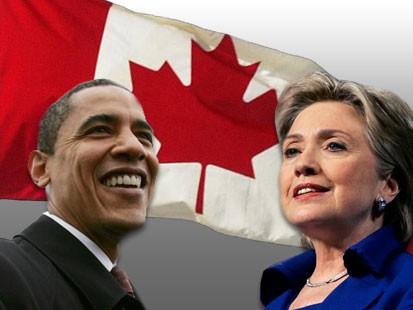 Senators Hillary Rodham Clinton and Barack Obama in the Democratic primaries are criticizing the North American Free Trade Agreement with Canada and Mexico and vowing to renegotiate it to protect American workers.

 [WHAT SARKOZY IS REALLY SAYING, IN NUANCED FRENCH FASHION, IS THAT, GIVEN THE PRESENT ERA OF GLOBALIZATION
 Mandelson has broad powers to negotiate trade agreements on behalf of the 27-nation bloc, but France is doing its best to handcuff him and organized a caucus of 20 farm ministers last month to warn against further concessions on agriculture.
 Mandelson has broad powers to negotiate trade agreements on behalf of the 27-nation bloc, but France is doing its best to handcuff him and organized a caucus of 20 farm ministers last month to warn against further concessions on agriculture.


