Prospects grim as negotiators push for a global trade deal
By Paul Taylor
Reuters
Monday, March 10, 2008
International Herald Tribune
BRUSSELS: To hear some U.S. presidential candidates and European leaders talk, you would think hard times lay ahead for advocates of free trade.
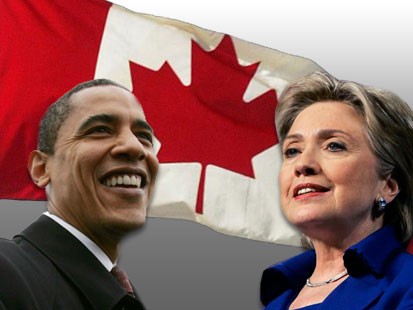 Senators Hillary Rodham Clinton and Barack Obama in the Democratic primaries are criticizing the North American Free Trade Agreement with Canada and Mexico and vowing to renegotiate it to protect American workers.
Clinton, with strong backing from U.S. organized labor, has advocated a "time out" in trade liberalization and questioned whether the theory of comparative advantage that underpins free trade still applies in the 21st century.
On the other side of the Atlantic, President Nicolas Sarkozy of France has urged Europeans to stop being naïve about trade and to develop "a real system of community preferences" to protect European Union agriculture and industry from unfair competition.

 [WHAT SARKOZY IS REALLY SAYING, IN NUANCED FRENCH FASHION, IS THAT, GIVEN THE PRESENT ERA OF GLOBALIZATION
 IT IS NOW TIME TO UPDATE FORTRESS EUROPE'S PROTECTIONIST DEFENSES WITH NON-TARIFF TECHNICAL BARRIERS TO TRADE DISGUISED AS 'CULTURAL PREFERENCES']
Political opposition has forced the EU's trade commissioner, Peter Mandelson, to delay changes in anti-dumping duties meant to take account of the interests of European firms that produce goods in low-cost countries.
 Mandelson has broad powers to negotiate trade agreements on behalf of the 27-nation bloc, but France is doing its best to handcuff him and organized a caucus of 20 farm ministers last month to warn against further concessions on agriculture.
Brussels trade diplomats say that the commissioner, who is British, has long been viewed with suspicion in many member states because of his liberal views on trade and that his influence may be waning.
 Mandelson has broad powers to negotiate trade agreements on behalf of the 27-nation bloc, but France is doing its best to handcuff him and organized a caucus of 20 farm ministers last month to warn against further concessions on agriculture.
Brussels trade diplomats say that the commissioner, who is British, has long been viewed with suspicion in many member states because of his liberal views on trade and that his influence may be waning.
All this sets a grim backdrop for negotiators at the World Trade Organization, who are preparing yet another "final push" for a global deal to cut tariffs and remove trade barriers. Their aim is to clinch a deal before President George W. Bush leaves office next January.
Turmoil on financial markets and a sharp economic slowdown, especially in the United States, have fueled calls for protecting jobs in wealthy countries.
The trade organization's director general, Pascal Lamy, says the downturn on both sides of the Atlantic should focus minds on the benefits of a trade agreement, not least because failure would damage confidence in the world economy. Keith Rockwell, a spokesman for the agency, said, "Do you fix the roof when the sun is shining or when it's raining? Either way, it's still a good idea to fix the roof."
Politically, a failure of the rules-based multilateral system to deliver progress on trade could undermine European hopes for a more ambitious international agreement in 2009 to curb the greenhouse gas emissions that are blamed for global warming.
As with climate change, a trade deal requires concessions from big emerging nations like India, Brazil and China, which want to be able to protect key sectors of their economies from competition from rich countries.
Those conflicts seriously threaten the trade talks, as does the reluctance of wealthy nations to reduce radically the longstanding protection of their farmers.
"I share the skepticism that anything good will come out of the Doha Development Agenda," said Adam Posen of the Peterson Institute for International Economics in Washington, using the name given to the trade round that began in Qatar in 2001.
Posen said that whoever wins the White House in November, Congress will make trade conditional on labor and environmental standards to shut out cheap competition, mainly from Asia.
Andre Sapir, a trade economist at the Free University of Brussels and former adviser to the European Commission, agrees that the climate in the United States is not favorable for new trade deals, although the Europeans should still push for one.
"You need some bad economic news to make a trade agreement necessary as a booster of confidence," he said. "But even if there is a deal now, the chances are that something is going to be reopened after the U.S. election."
U.S. trade diplomats in Europe are using Clinton's rhetoric and fears of a more protectionist U.S. administration to try to focus on the need to complete a trade deal now.
One senior diplomat, speaking on condition of anonymity because of the sensitivity of the issue, said his message to European counterparts was: "Don't wait for Hillary."
Turmoil on financial markets and a sharp economic slowdown, especially in the United States, have fueled calls for protecting jobs in wealthy countries.
The trade organization's director general, Pascal Lamy, says the downturn on both sides of the Atlantic should focus minds on the benefits of a trade agreement, not least because failure would damage confidence in the world economy. Keith Rockwell, a spokesman for the agency, said, "Do you fix the roof when the sun is shining or when it's raining? Either way, it's still a good idea to fix the roof."
Politically, a failure of the rules-based multilateral system to deliver progress on trade could undermine European hopes for a more ambitious international agreement in 2009 to curb the greenhouse gas emissions that are blamed for global warming.
As with climate change, a trade deal requires concessions from big emerging nations like India, Brazil and China, which want to be able to protect key sectors of their economies from competition from rich countries.
Those conflicts seriously threaten the trade talks, as does the reluctance of wealthy nations to reduce radically the longstanding protection of their farmers.
"I share the skepticism that anything good will come out of the Doha Development Agenda," said Adam Posen of the Peterson Institute for International Economics in Washington, using the name given to the trade round that began in Qatar in 2001.
Posen said that whoever wins the White House in November, Congress will make trade conditional on labor and environmental standards to shut out cheap competition, mainly from Asia.
Andre Sapir, a trade economist at the Free University of Brussels and former adviser to the European Commission, agrees that the climate in the United States is not favorable for new trade deals, although the Europeans should still push for one.
"You need some bad economic news to make a trade agreement necessary as a booster of confidence," he said. "But even if there is a deal now, the chances are that something is going to be reopened after the U.S. election."
U.S. trade diplomats in Europe are using Clinton's rhetoric and fears of a more protectionist U.S. administration to try to focus on the need to complete a trade deal now.
One senior diplomat, speaking on condition of anonymity because of the sensitivity of the issue, said his message to European counterparts was: "Don't wait for Hillary."


