Showing posts with label climate change chicanery. Show all posts

Wednesday, March 26, 2008

Europe Shouldn't Wait for Hillary Or Obama If It Wishes To Secure Further Trade Liberalization During the Doha Round

http://www.iht.com/articles/2008/03/10/business/rtrinside11.php

Prospects grim as negotiators push for a global trade deal


By Paul Taylor


Reuters


Monday, March 10, 2008


International Herald Tribune


BRUSSELS: To hear some U.S. presidential candidates and European leaders talk, you would think hard times lay ahead for advocates of free trade.
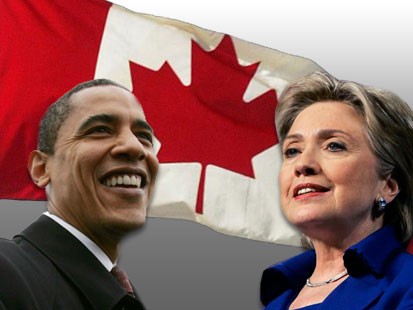
Senators Hillary Rodham Clinton and Barack Obama in the Democratic primaries are criticizing the North American Free Trade Agreement with Canada and Mexico and vowing to renegotiate it to protect American workers.


Clinton, with strong backing from U.S. organized labor, has advocated a "time out" in trade liberalization and questioned whether the theory of comparative advantage that underpins free trade still applies in the 21st century.


On the other side of the Atlantic, President Nicolas Sarkozy of France has urged Europeans to stop being naïve about trade and to develop "a real system of community preferences" to protect European Union agriculture and industry from unfair competition.

[WHAT SARKOZY IS REALLY SAYING, IN NUANCED FRENCH FASHION, IS THAT, GIVEN THE PRESENT ERA OF GLOBALIZATION
IT IS NOW TIME TO UPDATE FORTRESS EUROPE'S PROTECTIONIST DEFENSES WITH NON-TARIFF TECHNICAL BARRIERS TO TRADE DISGUISED AS 'CULTURAL PREFERENCES']


Political opposition has forced the EU's trade commissioner, Peter Mandelson, to delay changes in anti-dumping duties meant to take account of the interests of European firms that produce goods in low-cost countries.


Mandelson has broad powers to negotiate trade agreements on behalf of the 27-nation bloc, but France is doing its best to handcuff him and organized a caucus of 20 farm ministers last month to warn against further concessions on agriculture.


Brussels trade diplomats say that the commissioner, who is British, has long been viewed with suspicion in many member states because of his liberal views on trade and that his influence may be waning.

All this sets a grim backdrop for negotiators at the World Trade Organization, who are preparing yet another "final push" for a global deal to cut tariffs and remove trade barriers. Their aim is to clinch a deal before President George W. Bush leaves office next January.


Turmoil on financial markets and a sharp economic slowdown, especially in the United States, have fueled calls for protecting jobs in wealthy countries.


The trade organization's director general, Pascal Lamy, says the downturn on both sides of the Atlantic should focus minds on the benefits of a trade agreement, not least because failure would damage confidence in the world economy. Keith Rockwell, a spokesman for the agency, said, "Do you fix the roof when the sun is shining or when it's raining? Either way, it's still a good idea to fix the roof."


Politically, a failure of the rules-based multilateral system to deliver progress on trade could undermine European hopes for a more ambitious international agreement in 2009 to curb the greenhouse gas emissions that are blamed for global warming.


As with climate change, a trade deal requires concessions from big emerging nations like India, Brazil and China, which want to be able to protect key sectors of their economies from competition from rich countries.


Those conflicts seriously threaten the trade talks, as does the reluctance of wealthy nations to reduce radically the longstanding protection of their farmers.


"I share the skepticism that anything good will come out of the Doha Development Agenda," said Adam Posen of the Peterson Institute for International Economics in Washington, using the name given to the trade round that began in Qatar in 2001.


Posen said that whoever wins the White House in November, Congress will make trade conditional on labor and environmental standards to shut out cheap competition, mainly from Asia.


Andre Sapir, a trade economist at the Free University of Brussels and former adviser to the European Commission, agrees that the climate in the United States is not favorable for new trade deals, although the Europeans should still push for one.


"You need some bad economic news to make a trade agreement necessary as a booster of confidence," he said. "But even if there is a deal now, the chances are that something is going to be reopened after the U.S. election."


U.S. trade diplomats in Europe are using Clinton's rhetoric and fears of a more protectionist U.S. administration to try to focus on the need to complete a trade deal now.


One senior diplomat, speaking on condition of anonymity because of the sensitivity of the issue, said his message to European counterparts was: "Don't wait for Hillary."

Wednesday, March 5, 2008

EU Has Long Held Developing World Hostage to Non-Scienced-Based Health & Environmental Standards Deemed Economically & Socially Harmful

http://www.itssd.org/Res%20Ipsa%20Loquitor/Res%20Ipsa%20Loquitor%20-%20Studies%20showing%20impact%20of%20overly%20stringent%20stds%20on%20developing%20countries.pdf


ITSSD Main Website Issues - Studies Evaluating Negative Impacts of Overly Stringent EU Standards on Developing Countries


I. Generally


II. World Bank and Other Studies Quantifying the Impacts of Technical Barriers to Trade


III. World Bank and Other Studies Examining EU Standards Relating to Aflatoxins, in Nuts, Dried Fruits and Cereals


IV. World Bank Study Evaluating EU Maximum Residue Level (MRL) Standards Relating to Tetracyline Use in Beef


V. World Bank Study Evaluating EU MRL Standards For Bananas


VI. World Bank Study Evaluating Impact of Trade on Air Pollution Standards in Developing Countries


VII. World Bank Study Evaluating How Environmental Standards Affect Developing Country Export Competition


VIII. World Bank Study Quantifying the Trade Impact of Sanitary and Phytosanitary (SPS) Standards on Sub-Saharan Africa

Overly Strict EU Environmental and Health Regulations Have Long Served as Protectionist Trade Barriers That Harm Developing Country Advancement

http://www.itssd.org/Res%20Ipsa%20Loquitor/Res%20Ipsa%20Loquitor%20-%20Developing%20Countries%20Trade%20Barriers%20Sust%20Dev.pdf


ITSSD Main Website Issues - Developing Countries, EU Regulatory Trade Barriers and 'Negative' Sustainable Development


I. Generally


II. DDT , Malarian and UN POPs Treaty


III. UN Basel Convention and the Waste and Recyling Trade in Asia


IV. The Developing World Response to the EU's Proposed (now Final) REACH Chemicals Regulation


V. Africa's Response to Europe's GM Moratorium


Monday, February 4, 2008

European Commission Considers Import Carbon Tariffs

European Commission Considers Import Carbon Tariffs


http://www.environmentalleader.com/2008/01/09/european-commission-considers-import-carbon-tariffs


Environmental Leader


January 9, 2008


The European Commission is contemplating a carbon tariff on goods from countries where greenhouse gas emission policies do not equal European standards, according to Business Week. The tariff system would force companies that export products to Europe to buy EU emissions permits through the Emissions Trading Scheme.


France strongly supports the tariff. European Trade Commissioner Peter Mandelson said that such a scheme would be hard to implement and could lead to trade disputes.


The European Commission is also considering an expansion of the ETS, according to Reuters.


Current trading of carbon credits on the ETS market is worth $37 billion annually, and the commission is considering a proposal that would greatly increase that value by decreasing the percentage of free carbon credits that are distributed to European power generators and manufacturers. 90 percent are currently given out for free whereas 60 percent would be auctioned off annually beginning in 2013.


Only a few months ago, the European Union gave parliamentary approval to a plan that requires airlines flying to and from Europe to offset some of their emissions by buying CO2 allowances on the open market.

Sudden EU Commission Change of Heart on CO2 Rules Against Industry???? It's the Economy Stupid!!

http://www.planetark.org/dailynewsstory.cfm/newsid/46516/story.htm


EU to Set Easier CO2 Regime for Heavy Industries


Paul Taylor


Planet Ark


January 21, 2008


BRUSSELS - Europe's steel, aluminium and cement industries will have a special, less strict regime for greenhouse gas emissions under European Commission proposals to fight climate change to be announced this week.


After weeks of intense lobbying by business and governments, EU sources said on Sunday those three energy-intensive industries would be introduced more slowly into a new system for auctioning permits to emit carbon dioxide (CO2) from 2013.


The sources insisted on anonymity because wrangling is continuing in the Commission on final details of the proposals on CO2 emissions, renewable energy sources, biofuels and carbon sequestration to be unveiled on Wednesday.


A key flaw of the EU's Emissions Trading Scheme -- the main instrument for curbing pollution blamed for global warming -- has been that governments issued emission permits for free, handing industry windfall profits.


Under a planned reform, the sources said most sectors covered by the ETS will have to buy about one-fifth of emission permits from 2013 -- fewer than in early drafts of the proposal -- rising annually to reach 100 percent in 2020.


Those sectors include energy and power generation, including refineries, despite fierce lobbying by European oil majors BP and Shell to go easy on refineries.


The overall aim is to reduce European emissions of CO2 by at least 20 percent by 2020 compared to 1990 levels.


[MY, MY: HOW EU ASPIRATIONS FOR ENLIGHTENED ENVIRONMENTALISM HAVE FALLEN!!]


However, the sources said the EU executive was sensitive to concerns that the three big energy-intensive industries could be driven out of Europe if subjected to the same regime.


[EU COMMISSION SMELLS THE COFFEE!!]


"Those concerns are being sufficiently taken into account through the benchmarking regime and a different allocation regime," one official said.


WHITTLED DOWN


He declined to give figures but said energy-intensive industries would have a bigger initial allocation than originally planned, a lower starting point for the percentage of emissions permits to be auctioned and a slower phase-in.


The Carbon Trust, a British government-funded body charged with helping companies cut emissions, warned earlier this month that cement, steel, aluminium, chemicals, fertiliser and pulp and paper businesses might be hurt by the stricter EU regime.


But the sources said officials had whittled down the number of energy-intensive sectors likely to enjoy special treatment to just the three.


Europe's top business lobby last week attacked Commission plans to implement the deep emissions cuts agreed by EU leaders last year, saying that auctioning pollution permits could hurt industry in global competition.


"In the absence of a comprehensive international agreement, auctioning of allowances will harm the competitiveness of European companies, especially in energy-intensive industries," BusinessEurope Secretary-General Philippe de Buck wrote in a letter to Commission President Jose Manuel Barroso.


The draft proposal provides for a review in 2011 of the impact on energy-intensive industries, depending on whether there has been an international pact on curbing emissions by then.


The EU package will also propose mandatory national targets for cutting CO2 emissions from buildings, heating and cooling and transport, as well as binding national targets for using renewable energy sources in power generation. (Editing by Caroline Drees)

EU Comes Clean on Climate Change Costs: GHG Reduction Rules Will Significantly Harm European Industry Competitiveness

http://www.environmentalleader.com/2008/01/10/new-eu-co2-plans-will-affect-heavy-industry


New EU CO2 Plans Will Affect Heavy Industry


January 10, 2008


EU officials have acknowledged that a new plan to tighten greenhouse gas admissions will take a toll on the competiveness of some heavy industries, reports this article. The new rules will be unveiled by the European Commission on January 23.


According to official documents, the aluminum producers would be most affected, while chemical, steel and cement makers, to comply with the new standards, would have to raise prices between 5 and 48 percent. Reportedly, the EU executive is still divided on whether to introduce measures that would protect some sectors, such as energy intensive industries.

[REPORTS LIKE THESE ONCE AGAIN VALIDATE PREVIOUS ITSSD RESEARCH]


Overall, it’s estimated that should the changes occur, Europe’s GDP would drop by 0.1 percent but that jobs lost in the affected industries would be offset by new opportunities in the low-carbon economy.


The commission is also considering a carbon tariff on goods from countries whose emission policies aren’t as strong as Europe’s.

Environmental Demagoguery: Measuring and Labeling Wine's Carbon Footprint is Needless Undertaking; Will Raise Consumer Costs & Reduces Quality of Life

Bordeaux To Measure Wine’s CO2 Footprint


Environmental Leader


January 29, 2008


http://www.environmentalleader.com/2008/01/29/bordeaux-to-measure-wines-co2-footprint


The Bordeaux Wine Board (CIVB) is launching a project to measure the GHG the region’s industry is producing. The project, called “Bilan Carbone” in French, will run for the next six months in association with the French Environment Agency, and the CIVB says the results will be released in September.


The aim of the study is to give an overview of all emissions resulting from growing and tending vines, making wine, and bottling, storage and delivery. It will also look at associated activities such as personnel, packaging, vine treatments and waste management. According to Roland Feredj, CIVB director, the study will cost about $70,000.Last November, the first-ever attempt at a carbon neutral vineyard in France began in Bordeaux’s Medoc region.

[MORE FRENCH PROTECTIONISM]


Another Bordeaux winemaking family, the Despagne Family, has already launched a carbon reduction project, planting 25 acres of sunflowers that will be used to produce fuel for tractors, but they said studying carbon emissions was a challenge. The Despagnes are using an Australian protocol, developed by Australian wine industry consultant, Provisor, and the Yalumba Wine Company, to measure their GHG and compare them with global standards.

*************************************************************************************
http://afp.google.com/article/ALeqM5gnFLyvTdnNFpzMEUeeN5bbRa0teg

Associated France Presse


Bordeaux to measure wine's CO2 footprint


BORDEAUX, France (AFP) —

The Bordeaux region, one of France's premier wine growing regions, is launching an ambitious project to measure the industry's greenhouse gas emissions to bolster its environmental standards.

The Bordeaux Wine Board (Conseil Interprofessionel des Vins de Bordeaux or CIVB) said it wanted to find out just how much carbon dioxide, one of the main culprits in global warming, it generated.

"We know we produce 756 million bottles of wine per year and that 40 percent of that is exported," said Laurent Charlier of the CIVB, who will be working with environmental consultant Jean Marc Jancovici on the project.


"This study should give a clear idea of what different methods of production or shipment mean, in terms of environmental cost," he said.


[THIS IS NOTHING MORE THAN FRENCH CLIMATE CHANGE CHICANERY - THE FRENCH WINE INDUSTRY IS UNDER INCREASING COMPETITION FROM LOWER COST PRODUCERS FROM AROUND THE WORLD...]

The project, called "Bilan Carbone" in French, will run for the next six months in association with the French Environment Agency (ADEME), and the CIVB says the results will be released in September.


Jancovici, who has worked with the French government, France Telecom, Sony, Alcatel and luxury goods company LVMH, was also responsible for a similar project for producers in the Champagne region.


CIVB director, Roland Feredj, said the launch in October last year of France¹s national environmental action plan was in part responsible for the CIVB initiative but there is a practical side as well.

"Everyone is concerned with the costs of (wine) production, so if we can find ways of saving money and reducing carbon emissions, that would be ideal."

The aim of the study, which Feredj said would cost about 50,000 euros (70,000 dollars), are to give an overview of all emissions resulting from growing and tending vines, making wine, and bottling, storage and delivery.


It will also look at associated activities such as personnel, packaging, vine treatments and waste management.


"We intend to find out the carbon emissions for making different styles of wine," Charlier said. "And at what stages we need to concentrate our efforts to mitigate the emissions."

One Bordeaux winemaking family that has already launched a carbon reduction project, planting 10 hectares (25 acres) of sunflowers that will be used to produce fuel for tractors, welcomed the move, but said studying carbon emissions was a challenge.

"We think it's good and we are going to be part of the study group," said Aymeric Fournier for the Despagne Family which owns 300 hectares of vineyards in Bordeaux.

"This will give us an overview of the situation but it is a complicated thing to do," he warned.
"We started seriously in the spring of 2007 -- although we had already planted the sunflowers -- to look at our carbon emissions but deciding how far to take each measurement is not easy," Fournier said.


"For example, with any of the products needed for the vineyard we need to ask, how far has this come, how much carbon was emitted in its making? Or take the different cars and different distances that employees drive to work. It is a very detailed calculation," he said.


The Despagnes are already using an Australian protocol, developed by Australian wine industry consultant, Provisor, and the Yalumba Wine Company, to to measure their greenhouse gas emissions and compare them with global standards.

"It is quite a piece of work but we are determined to go ahead with it. It helps so much to have this kind of framework. We were a bit stumped as to where to go next before we saw this," Fournier said. "

Sunday, January 27, 2008

India, Brazil Slam New Attempts by EU & US to Secure Green Trade Barriers at Doha

http://www.alertnet.org/thenews/newsdesk/L04357213.htm


India, Brazil slam new WTO Doha proposals


04 Dec 2007

Reuters


By Jonathan Lynn


India and Brazil criticised two new sets of proposals in the Doha round of trade talks at the World Trade Organisation (WTO) on Tuesday, signalling that wide gaps in the negotiations remain despite recent progress.


The two developing countries, who play a major role in the talks, said that a U.S.-EU proposal to free up trade in environmental goods was little more than a disguised attempt to boost sales of goods of rich nations.


They also said a negotiating text on "rules" -- anti-dumping, subsidies and fisheries subsidies -- was a step backwards that excessively accommodated U.S. concerns.


India also expressed alarm that the key agriculture talks were tilting too much towards the needs of rich countries and were ignoring the requirements of the sub-continent's millions of subsistence farmers.


India has been committed to the Doha talks, launched six years ago and now aiming for conclusion next year, said India's WTO ambassador Ujal Singh Bhatia.


"But if, God forbid, a time comes when that price of engagement is unpayable by us, then we will have to stand up and say that," he told Reuters.


NO BASIS FOR NEGOTIATION


The United States and the European Union launched a proposal in the long-running Doha talks last Friday to counter climate change by eliminating tariffs on 43 climate-friendly goods and setting up a wider agreement on environmental goods and services for developed and advanced developing countries.


"We don't think it's a basis for negotiation on environmental products," said Brazil's top trade negotiator, Roberto Azevedo. "Brazil is deeply disappointed with the proposal. We find the proposal modest, we find it biased and we find it protectionist," he told a briefing. Azevedo noted that the U.S.-EU proposal made no reference to biofuels, of which Brazil is a major producer, or the technologies to produce them, and said the list was geared to U.S.-EU products. "Anything that they don't produce is not on the list," he said.


Bhatia said India could support proposals to free up trade in goods whose sole use was countering climate change, such as solar panels or windmills, but the list could be extended over time to new models of cars or refrigerators that were more energy-efficient, and that was unacceptable.


"Their list is a disguised effort at getting market access through other means and does not satisfy the mandate for environment," he said.


Both Brazil and India expressed dismay at the rules proposal that met U.S. concerns by allowing a controversial method of calculating anti-dumping duties called zeroing. This would allow the abuse of trade remedies to foster protectionism, they said.


Washington had said it was disappointed at last Friday's proposals, but added they were a basis for negotiation.


Bhatia said the proposals on banning most fisheries subsidies, welcomed by environmental groups, would cause India difficulty as it tries to improve the living conditions of its fishermen, among the poorest people in the country.


The proposals do give some leeway to developing countries to support fishermen, but he said the conditions, such as setting up approved fisheries management schemes, were too onerous.


Senior Indian Commerce Department official Jayant Dasgupta said a disproportionate effort in the WTO's key agriculture talks was going into shielding the commercial interests of the relatively small number of farmers in rich countries.


At the same time poor countries were being squeezed on proposals to protect the livelihoods of subsistence farmers making up the majority of the population -- 65 percent in India's case.


India needed to shield such people, often living on less than $1 a day, from market fluctuations, and encourage them to stay on the land to ensure food security for the country.

Saturday, January 26, 2008

Protectionists Within 110th Congress Toyed With Bringing Global Trade War; Considered Carbon Emissions Limits & Carbon Border Taxes!

http://www.economist.com/opinion/displaystory.cfm?story_id=10134052


Climate change - Green protectionism


Nov 15th 2007


From The Economist print edition [ECONOMIST APPROVES OF ALL U.S. LEGISLATION THAT HELPS OUT EUROPEAN INDUSTRIES]


A dangerous flaw in a bill to control carbon emissions


FOR those (such as this newspaper) who argue that the only way to avert dangerous climate change is to set a price on CO2 emissions, what's going on in America's Congress is excellent news. A bill to set such a price has achieved a remarkable degree of cross-party support (see article). Federal emissions controls in America are essential to tackling climate change globally. So it is especially unfortunate that the bill includes a provision that would turn the fight against climate change into a tool for protectionists.


While Al Gore has been strutting his stuff on stage, behind the scenes America's quieter greens have been successfully lobbying powerful interests. Many companies have come round to the view that they would do better with a single federal system than a patchwork of state-level rules. Farmers have bought the idea that they can make money out of biofuels. Christians have been persuaded that they need to be better stewards of the earth. Defence hawks have been arguing that America needs to reduce its dependency on the Middle East.


But two powerful groups have remained determinedly sceptical: energy-intensive manufacturers and organised labour, who fear the effects of higher energy costs in America and their impact on jobs.


The main purpose of the bill is to establish a carbon price through a cap-and-trade system. The proposal is a reasonable one, informed by the experience of Europe's similar scheme.


[IT MUST BE RECALLED IN A PRIOR FINANCIAL TIMES ARTICLE POSTED IN THIS BLOG THAT THE EU COMMISSION HAS ADMITTED ITS FLAWED ENERGY POLICY FOCUSING ON EMISSIONS CAP LIMITS!!!]


But to placate the manufacturers and the unions, the bill also includes a measure which Europe has rightly abjured (although some member states have recently been demanding one) for a border tax on carbon-intensive goods. Imports would have to be certified as to their carbon content, and would be taxed accordingly.


Proponents of the idea argue, first, that American producers would otherwise be disadvantaged by the higher costs that their country's stricter standards impose on them. Second, they maintain, a tax would encourage developing-country governments to cut the carbon-intensity of their economies for fear of losing lucrative export markets.


Be green and grow


[IT MUST BE RECALLED THAT THE FRENCH ATTALI COMMISSION RECENTLY RECOMMENDED THAT THE PRECAUTIONARY PRINCIPLE, WHICH SERVES AS THE LEGAL BASIS FOR ENACTING SUCH DRACONIAN RULES REFLECTS THAT 'ENLIGHTENED' PRECAUTIONARY PRINCIPLE-BASED ENVIRONMENTALISM IMPOSES LIMITS TO GROWTH]**


On the first argument, if America establishes a carbon price, an energy-intensive industry such as aluminium would very likely choose to expand capacity elsewhere. Yet it is not clear that, in the long run, environmental regulation does much to suppress economic growth. After all, California imposes tighter rules on companies than do most other American states, but its long boom suggests that greenery and growth can coexist comfortably. [CALIFORNIA, TO BE SURE, IS A VERY EXPENSIVE STATE TO DO BUSINESS IN, LET ALONE TO LIVE IN!!!]


[IF IT IS NOT CLEAR THAT GROWTH IS IMPAIRED BY ENVIRONMENTAL REGULATION, WHY REGULATE IN THIS MANNER???]


China and India might well come more swiftly to the negotiating table if they faced the possibility of losing their export markets. [CHINA AND INDIA WOULD BE IMPAIRING THEIR ABILITY TO DEVELOP WERE THEY TO ADOPT UNREALISTIC CARBON EMISSIONS LIMITS AND CARBON BORDER TAXES!!]


But the experience of America and Europe suggests that threatening trade sanctions is not the only way to bring a country round. After all, Europe set a carbon price without imposing tariffs on American goods, and America looks like following its lead anyway. What's more, the costs of a border tax could be huge, not just because of the massive bureaucracy needed to certify the carbon content of different goods imported from different factories in different countries, but also because such a tax would be a dangerous weapon in the hands of America's growing gang of protectionists.


The people who worry most about the costs of trying to constrain carbon emissions are the very ones demanding protectionist measures. But if those measures are passed, America risks something far costlier than a switch to cleaner energy: a global trade war.


[CONSIDERATION BY US LEGISLATORS AND INDUSTRIES OF SUCH RIDICULOUS LEGISLATION HAS BEEN NO DOUBT TRIGGERED BY A MISTAKEN BELIEF THAT EUROPE'S GLOBAL PRECAUTIONARY PRINCIPLE ENVIRONMENTAL JUGGERNAUT WILL SUCCEED!!]


Friday, January 25, 2008

EU Climate Change Chicanery: ITSSD Research Findings on European Disguised Protectionism Validated

http://www.boston.com/news/world/europe/articles/2008/01/22/us_warns_eu_on_using_climate_change_as_pretext/


http://www.iht.com/articles/2008/01/21/business/carbon.php


US warns EU on using climate change as pretext

By James Kanter and Stephen Castle,

International Herald Tribune,

22 January 2008


Official says it has been an excuse for protectionism


BRUSSELS - The United States warned the European Union yesterday against using climate change as a pretext for protectionism, setting the stage for trans-Atlantic tension over a new package of EU measures to combat global warming.


The pointed comments by the US trade representative, Susan Schwab, after talks in Brussels, came just two days before the European Commission introduced its proposals for cutting EU emissions at least 20 percent from 1990 levels by 2020.


"We have been dismayed at a variety of suggestions where we have seen the climate and the environment being used as an excuse to close markets," Schwab said after discussions with Peter Mandelson, her European counterpart.


President Nicolas Sarkozy of France has called for a carbon tax on imports to ensure that European companies that need to comply with tough environmental rules are not undercut by foreign competitors whose governments are not capping carbon emissions.


EU officials were not expected to propose such a measure tomorrow but were expected to keep alive the possibility of a so-called border tax to keep European industries competitive.


The EU pledge to protect European industry by 2011 at the latest will be aimed at assuaging powerful lobby groups from sectors like steel and aluminum manufacturing, which say they are facing higher costs than their overseas competitors because of the EU's determination to lead the world in climate protection.


Even so, EU officials hope to be able to avoid the issue, not least because any European border tax could be challenged at the World Trade Organization.


Instead, EU officials hope that other developed countries like the United States, which did not sign the Kyoto climate treaty, will join an international treaty by the end of the decade, making protectionist measures unnecessary.


Measures other than the border tax that are under discussion by EU officials and diplomats in Brussels include granting greater numbers of free pollution permits than planned. Officials say they believe such a method would not break world trade rules.


The EU also could condone global agreements within sectors like steel and cement, rather than between nations.


In that scenario, industries worldwide in a particular manufacturing sector would agree to cut their pollution by a certain amount, in theory leveling the competitive playing field.


EU officials say they are optimistic about a global climate accord after the recent meeting of nearly 200 nations in Bali, Indonesia, where agreement was reached on laying out a plan for negotiations that could produce a climate treaty by 2009.


But the Bali Action Plan faces high hurdles, including the persistently thorny problem of convincing the United States to take action even if fast-developing countries like China, which insists on developments getting higher priority than emissions curbs, fail to make similar pledges.


Schwab also took issue with Europe's attitude toward genetically modified foods, which she described as "perfectly safe."


She singled out France's decision to go slowly on cultivation of genetically modified corn.