Showing posts with label precautionary principle. Show all posts

Thursday, June 12, 2008

Has Barack Transformed Himself into EURObama Given His Interest in Adopting as US Law the Well-Known EU REACH Green Regulatory Trade Barrier??

http://www.washingtonpost.com/wp-dyn/content/article/2008/06/11/AR2008061103569_pf.html

Chemical Law Has Global Impact: E.U.'s New Rules Forcing Changes By U.S. Firms


By Lyndsey Layton


Washington Post


June 12, 2008


Europe this month rolled out new restrictions on makers of chemicals linked to cancer and other health problems, changes that are forcing U.S. industries to find new ways to produce a wide range of everyday products.

The new laws in the European Union require companies to demonstrate that a chemical is safe before it enters commerce -- the opposite of policies in the United States, where regulators must prove that a chemical is harmful before it can be restricted or removed from the market.


[THIS IS TANTAMOUNT TO REQUIRING INDUSTRY TO PROVE A 'NEGATIVE' - i.e., THAT SOMETHING IS TOTALLY SAFE WITH ZERO RISK - SOMETHING THAT IS NEITHER HUMANLY POSSIBLE NOR REALISTIC.]


Manufacturers say that complying with the European laws will add billions to their costs, possibly driving up prices of some products.


[THIS IS FACT, NOT FICTION. THE PROPONENTS ALMOST ALWAYS MINIMIZE THE COSTS WHILE EXTOLLING THE BENEFITS.]


The changes come at a time when consumers are increasingly worried about the long-term consequences of chemical exposure and are agitating for more aggressive regulation. In the United States, these pressures have spurred efforts in Congress and some state legislatures to pass laws that would circumvent the laborious federal regulatory process.


[THE CONGRESSIONAL PRESSURE REFERRED TO ABOVE HAS LONG PROCEEDED FROM POLICALLY MOTIVATED DEMOCRATIC CALIFORNIA CONGRESSMAN HENRY WAXMAN. See: Lawrence A. Kogan, Claims of Improper US Lobbying Quite a REACH, EU Reporter (May 2004 Plenary Issue at p. 18) at: http://www.itssd.org/Publications/1-20_EUR_04May04.pdf ].


[THE 'CONSUMERS' REFERRED TO HERE ARE NONE OTHER THAN THE PERSONS WHO OPERATE THE EXTREMIST ENVIRONMENTAL, CONSUMER & HEALTH GROUPS THAT WANT US ALL TO LIVE IN A CLINICALLY PURE WORLD, FREE FROM RISK. THEY WANT US, IN OTHER WORDS, TO LIVE IN A BUBBLE. DON'T PEOPLE REMEMBER THE ABSURDITY OF SEINFELD'S 'BUBBLE-BOY'???]
["'The Bubble Boy' is the 47th episode of the American sitcom Seinfeld, as well as the nickname of Donald Sanger, one of the characters in the episode...Jerry, George, George's girlfriend Susan, and Elaine plan to travel to Susan's family's lakeside cabin. Before then, Elaine meets with a kindly father who describes the sad life of his young son Donald who lives in a plastic 'bubble' (a germ-free quarantine). As Donald is a fan of Jerry's, Jerry is forced by Elaine to visit Donald on the way to the cabin to cheer him up. However, Jerry gets lost and George and Susan arrive before him. While waiting for Jerry to arrive, they play Trivial Pursuit with the "bubble boy," who is in fact actually an adult, and not a mere boy...The Trivial Pursuit game ends prematurely when George disputes the answer to the question "Who invaded Spain in the 8th century?" The boy answers with "the Moors", but the question card says "the Moops" due to a misprint, and George refuses to give Donald credit. Donald attacks George and the "bubble" is punctured and depressurized in the struggle. Although everyone blames George for popping the bubble, technically, Susan causes it as she tries to defend George from Donald's attack." See: The Bubble Boy (Seinfeld episode), Wikipedia, at: http://en.wikipedia.org/wiki/The_Bubble_Boy_(Seinfeld_episode) .]


Adamantly opposed by the U.S. chemical industry and the Bush administration, the E.U. laws will be phased in over the next decade. It is difficult to know exactly how the changes will affect products sold in the United States. But American manufacturers are already searching for safer alternatives to chemicals used to make thousands of consumer goods, from bike helmets to shower curtains.

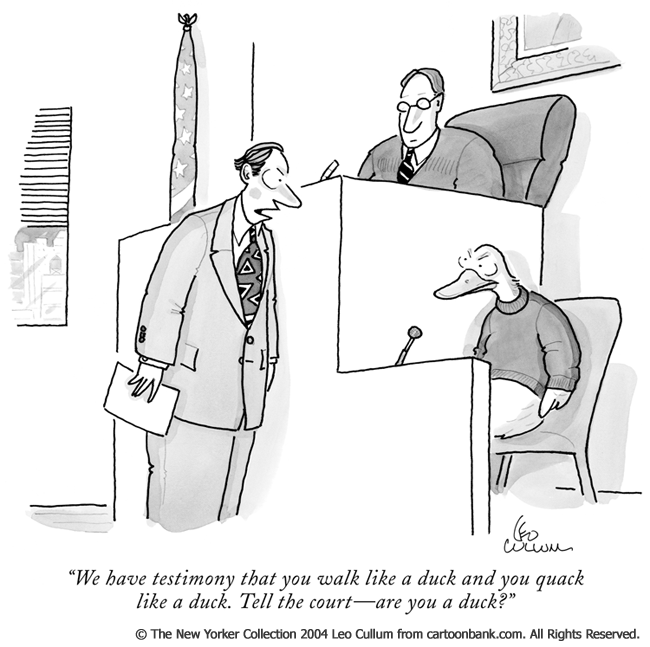
[ACTUALLY, THE EU REACH REGULATORY REGIME HAS BEEN OPPOSED BY INDUSTRIES THROUGHOUT THE WORLD ON THE GROUNDS THAT IT IS A FALSE PRETENSE FOR HEALTH & ENVIRONMENTAL SAFETY-BASED PROTECTIONISM, MODELED AFTER THE EU'S FAMOUS GENETICALLY MODIFIED (GM) 'FRANKENFOOD' REGULATORY SCARE THAT PERSISTS TO THIS DAY.


See: Lawrence A. Kogan, Enlightened Environmentalism or Disguised Protectionism: Assessing the Impact of EU Precaution-Based Standards on Developing Countries, National Foreign Trade Council (April 2004) at pp. 65-86, at:
http://www.wto.org/english/forums_engo_eposp47_nftc_enlightened_e.pdf ; Lawrence A. Kogan, Trade protectionism : Ducking the Truth About Europe's GMO Policy, International Herald Tribune (Nov. 27, 2007), at: http://www.iht.com/articles/2004/11/27/edkogan_ed3_.php?page=1 ; Lawrence A. Kogan, Ducking The Truth About EU GM Policy -Looks Like a Duck, But is it a Decoy?, EU Reporter (Oct. 22, 2004) at p. 6, at: http://www.itssd.org/Publications/Ducking%20the%20Truth%20About%20EU%20GM%20Policy.pdf.]


The European Union's tough stance on chemical regulation is the latest area in which the Europeans are reshaping business practices with demands that American companies either comply or lose access to a market of 27 countries and nearly 500 million people.


[THE EU REACH REGULATION ARGUABLY VIOLATES WTO LAW. See: Lawrence A. Kogan, EU REACH Adoption Likely to Trigger WTO Action (Dec. 15, 2006) at: http://www.itssd.org/pdf/PressRelease-EUREACHAdoption.pdf ; Lawrence A. Kogan, REACHING For Your Wallets Or Your Lives, (Dec. 15, 2006) at: http://www.itssd.org/Publications/REACHing-for-Your-Wallets.pdf ; Lawrence A. Kogan, WTO ‘Fever’ Necessary to Stem Advance Of Precautionary Principle ‘Virus’, Says ITSSD (March 27, 2007) at: http://www.itssd.org/Press%20Release/WTOFeverNecessarytoStemAdvanceofPrecautionaryPrincipleVirusSaysITSSDII3.pdf ].

From its crackdown on antitrust practices in the computer industry to its rigorous protection of consumer privacy, the European Union has adopted a regulatory philosophy that emphasizes the consumer. Its approach to managing chemical risks, which started with a trickle of individual bans and has swelled into a wave, is part of a European focus on caution when it comes to health and the environment.


[THE EU CRACKDOWN ON ANTITRUST PRACTICES IS LARGELY ATTRIBUTABLE TO THE LACK OF DUE PROCESS REQUIREMENTS IN EUROPE. PERSONS, LEGAL OR OTHERWISE, ARE PRESUMED GUILTY UNTIL PROVEN INNOCENT. THERE IS NO COMMON LAW REQUIREMENT FOR LAW ENFORCEMENT AUTHORITIES TO OBTAIN A WARRANT PRIOR TO AN ARREST BASED ON THE NOTION OF 'PROBABLE CAUSE'. IS THIS THE TYPE OF LEGAL SYSTEM (BASED ON EUROPEAN CONTINENTAL LAW) THAT WE WANT IN AMERICA??? IS THIS THE TYPE OF 'CHANGE' THAT BARACK OBAMA IS SPEAKING OF??]


"There's a strong sense in Europe and the world at large that America is letting the market have a free ride," said Sheila Jasanoff, professor of science and technology studies at Harvard University's John F. Kennedy School of Government. "The Europeans believe . . . that being a good global citizen in an era of sustainability means you don't just charge ahead and destroy the planet without concern for what you're doing."


[THIS IS A SELF-SERVING, FALSE & MISREPRESENTATIVE POLITICAL STATEMENT THAT IS WITHOUT SCIENTIFIC FOUNDATION. JUST BECAUSE MS. JASANOFF HARKENS FROM HARVARD DOESN'T GIVE HER THE RIGHT TO CLAIM ACADEMIC CREDIBILITY. EUROPE IS UNDERTAKING A 'WITCH HUNT' TO FIND SOMETHING THAT LOOKS LIKE SCIENTIFIC EVIDENCE TO SUPPORT ITS SPURIOUS CLAIMS THAT CHEMICALS MANUFACTURERS, FORMULATORS AND USERS ARE HARMING PUBLIC HEALTH & ENVIRONMENT.]


Under the E.U. laws, manufacturers must study and report the risks posed by specific chemicals.

Through the Internet, the data will be available for the first time to consumers, regulators and potential litigants around the world. Until now, much of that information either did not exist or was closely held by companies.


[THE EXISTENCE OF INFORMATION BY ITSELF MEANS LITTLE. THE EU'S PROBLEM IS THAT IT HAS ACCUMULATED SO MUCH INFORMATION FOR ACCUMULATION SAKE - THAT IS, BECAUSE IT CAN, THAT IT DOESN'T KNOW WHAT IT ALL MEANS, AND THEREFORE, WHAT TO DO WITH IT!!]


"This is going to compel companies to be more responsible for their products than they have ever been," said Daryl Ditz, senior policy adviser at the Center for International Environmental Law. "They'll have to know more about the chemicals they make, what their products are and where they go."


[KNOWING THE HAZARDOUS CHARACTERISTICS OF CHEMICALS ALONE DOES NOT TRANSLATE INTO MAKING SAFER PRODUCTS. KNOWING HOW CHEMICALS ARE TO BE USED, WHO WILL USE THEM, & UNDER WHAT CONDITIONS, WILL PERMIT COMPANIES TO MAKE SAFER PRODUCTS. HOWEVER, IT SHOULD NOT BE THE BURDEN OF COMPANIES TO ANTICIPATE THE UNANTICIPATABLE, AS THESE ACADEMICS AND THE EUROPEAN UNION WOULD LIKE THEM TO DO - UNLESS THE U.S. WISHES TO ADOPT THE SOCIALIST STYLE OF EUROPEAN REGULATION, WHICH DETERMINES WHAT PEOPLE CAN & CANNOT DO.]


The laws also call for the European Union to create a list of "substances of very high concern" -- those suspected of causing cancer or other health problems. Any manufacturer wishing to produce or sell a chemical on that list must receive authorization.


In the United States, laws in place for three decades have made banning or restricting chemicals extremely difficult. The nation's chemical policy, the Toxic Substances Control Act of 1976, grandfathered in about 62,000 chemicals then in commercial use. Chemicals developed after the law's passage did not have to be tested for safety. Instead, companies were asked to report toxicity information to the government, which would decide if additional tests were needed.


In more than 30 years, the Environmental Protection Agency has required additional studies for about 200 chemicals, a fraction of the 80,000 chemicals that are part of the U.S. market. The government has had little or no information about the health hazards or risks of most of those chemicals.


The EPA has banned only five chemicals since 1976. The hurdles are so high for the agency that it has been unable to ban asbestos, which is widely acknowledged as a likely carcinogen and is barred in more than 30 countries. Instead, the EPA relies on industry to voluntarily cease production of suspect chemicals.


"If you ask people whether they think the drain cleaner they use in their homes has been tested for safety, they think, 'Of course, the government would have never allowed a product on the market without knowing it's safe,' " said Richard Denison, senior scientist at the Environmental Defense Fund. "When you tell them that's not the case, they can't believe it."


The changes in Europe follow eight years of vigorous opposition from the U.S. chemical industry and the Bush administration. Four U.S. agencies -- the EPA, the Commerce Department, the State Department and the Office of the Trade Representative -- argued that the system would burden manufacturers and offer little public benefit.


In 2002, then-Secretary of State Colin L. Powell directed the staffs of American Embassies in Europe to oppose the measure. He cited talking points developed in consultation with the American Chemistry Council, a manufacturers trade group.


Mike Walls, the chemistry council's managing director of government and regulatory affairs, said that 90 percent of its members are affected by the E.U. laws and that some cannot afford the cost of compliance. "We're talking about over 850 pages of regulation," he said.


The E.U. standards will force many manufacturers to reformulate their products for sale there as well as in the United States. "We're not looking at this as a European program -- we're buying and selling all over the globe," said Linda Fisher, vice president and chief sustainability officer for DuPont and a former EPA deputy administrator.


DuPont expects to spend "tens of millions" of dollars to register about 500 chemicals with the European Union, Fisher said. About 20 to 30 are expected to make the list of "substances of very high concern."


[THIS CORPORATE PHILOSOPHY MORE LIKELY REFLECTS THE COMPANY'S RETICENCE TO CHALLENGE EU GOVERNMENTAL AUTHORITY EVEN IF THE COMPANIES ARE 'IN THE RIGHT', GIVEN THAT THE EU COMMISSION & THE UNITED NATIONS FUNDS NON-GOVERNMENTAL GREEN EXTREMIST GROUPS THAT WAGE PUBLIC REPUTATION DISPARAGEMENT CAMPAIGNS AGAINST COMPANIES THAT DON'T GO ALONG WITH COMMISSION &/OR NGO CORPORATE SOCIAL RESPONSIBILITY MANDATES. OTHER 'MULTINATIONAL COMPANIES HAVE EMBRACED THIS PHILOSOPHY TO ESCAPE THE GRASP OF THE NGOs. See: Lawrence A. Kogan, Precautionary Preference: How Europe Employs Regulatory Protectionism to Weaken American Free Enterprise, International Journal of Economic Development, Vol. 7, Nos. 2-3 (2005) at: http://www.itssd.org/White%20Papers/ijed-7-2-3-kogan.pdf . ]


One such chemical is likely to be perfluorooctanoic acid (PFOA), used to make Teflon and other substances used in food packaging, carpet, clothing and electrical equipment. A suspected carcinogen, it accumulates in the environment and in human tissue.


DuPont reached a $16.5 million settlement with the EPA in 2005 on charges that it illegally withheld information about health risks posed by PFOA and about water pollution near a West Virginia plant. Dupont and other companies have agreed to cease production by 2015.


Once a chemical is included on the E.U. list, manufacturers are likely to feel pressure to abandon production, observers say. "It will be a market signal that says, 'These are best to avoid,' " said Joel Tickner, director of the Lowell Center for Sustainable Production at the University of Massachusetts.


[THIS IS CALLED CHARACTERIZING ENVIRONMENTAL & HEALTH HAZARDS THROUGH BUREAUCRATIC CREATION OF LISTS OF 'BAD' SUBSTANCES WITHOUT FIRST SUBJECTING THEM TO EMPIRICAL SCIENCE-BASED RISK ASSESSMENTS TO DETERMINE THE SPECIFIC HARMS CAUSED BY SPECIFIC USES TO SPECIFIC HUMAN SPECIMENS OR SUBGROUPS OR ENVIRONMENTAL ECOSYSTEMS. SUCH 'LISTINGS' ARE REMINISCENT OF MARXIST SOVIET-STYLE REGULATIONS THAT ARE INTENDED TO STIGMATIZE THE PRODUCERS, FORMULATORS OR USERS OF SUCH 'LISTED' SUBSTANCES' SO THAT THEY CURTAIL THEIR ACTIVITIES WITHOUT PROOF OF MORE. THIS IS ENVIRONMENTAL SOCIALISM, A SECULAR RELIGION, PLAIN & SIMPLE, DESPITE WHAT THE ACADEMIC DEMAGOGUES PREACH. See: Lawrence A. Kogan, Exporting Europe's Protectionism, National Interest, No. 77 (Fall 2004) at: http://www.itssd.org/Publications/Kogan%20TNI%2077FINAL.pdf .]


Linking the word "concern" to a chemical is enough to trigger a market reaction. Earlier this year, when government officials in Canada and the United States said they worried about health effects possibly caused by bisphenol A (BPA), a chemical used in plastics, major retailers pulled from their shelves baby bottles containing the chemical.


[THIS IS OTHERWISE KNOWN AS GOVERNMENT & NGO FEARMONGERING. AND, IT IS REFLECTED IN EUROPE'S OPERATIVE PHILOSOPHICAL & LEGAL TOUCHSTONE, KNOWN AS THE 'STANDARD-OF-PROOF DIMINISHING, BURDEN-OF-PROOF-REVERSING, GUILTY-UNTIL-PROVEN-INNOCENT, 'I-FEAR-THEREFORE-I-SHALL-BAN', 'HAZARD- NOT-RISK-BASED' PRECAUTIONARY PRINCIPLE. IT ENTITLES GOVERNMENTS TO REGULATE ANYTHING THEY ESSENTIALLY DESIRE.]


IMAGINERY DANGERS WITHOUT EVIDENCE OF PROBABLE HARM.]


"When we see lead in toys and BPA in baby bottles, all of these things arouse a kind of parental anxiety that overrides any counter-arguments based on science that industry might make," Jasanoff said.


[THIS IS ESPECIALLY TRUE WHEN WE HAVE GRANT-SEEKING ACADEMICS LIKE MS. JASANOFF WHO CRAVE PUBLIC ATTENTION & ADULATION.]


In the absence of strong federal regulations in the United States, a patchwork system is emerging. Individual states are banning specific chemicals, and half a dozen lawmakers on Capitol Hill have introduced bills aimed at shutting down production of various chemicals.


[THIS IS A MISNOMER. THE U.S. HAS AMONG THE STRONGEST FEDERAL REGULATIONS ON CHEMICALS IN THE WORLD. THIS IS NOT THE PROBLEM. THE PROBLEM CONCERNS EUROPE'S PENCHANT FOR REGULATORY PROTECTIONISM THAT ASSUMES THE FORM OF UNSCIENTIFIC ENVIRONMENTAL & HEALTH REGULATIONS JUSTIFIED THROUGH THE USE OF PUBLIC FEAR-PROMOTING CAMPAIGNS EMPLOYED BY EUROPEAN GOVERNMENT-FUNDED NONGOVERNMENTAL ORGANIZATIONS (NGOs).]


Sen. Frank Lautenberg (D-N.J.) introduced a measure last month that would overhaul U.S. chemical regulation along the lines of the new European approach. It would require the Centers for Disease Control and Prevention to use biomonitoring studies to identify industrial chemicals present in umbilical cord blood and decide whether those chemicals should be restricted or banned. A study by the nonprofit Environmental Working Group found an average of 200 industrial chemicals in the cord blood of newborns.


[THE RECENT LAUTENBERG/WAXMAN INITIATIVE REFLECTS THE SOCIALIST PROCLIVITIES OF THE DEMOCRATIC PARTY-DOMINATED NEW JERSEY & WASHINGTON, DC LEGISLATURES. APPARENTLY, HE AND OTHER DEMOCRATS HAVE BEEN WORKING BEHIND CLOSED DOORS FOR SEVERAL YEARS WITH THE EUROPEAN COMMISSION, MOST LIKELY WITH A FAVORABLE NOD FROM OBAMA. See: EU chemicals law REACH inspires US bill, Euractiv.com (July 18, 2005 Updated: May 21, 2007, at: http://www.euractiv.com/en/environment/eu-chemicals-law-reach-inspires-us-bill/article-142660 ; US Eyes REACH-style Law for Chemicals, Euractiv.com (June 3, 2008), at: http://www.euractiv.com/en/environment/us-eyes-reach-style-law-chemicals/article-172968 ; Senators Obama, Lautenberg Say Chemical Plant Security Legislation is Far too Weak, Fails to Protect Millions of Americans, Barack Obama, U.S. Senator From Illinois Website, Press Release (Sept. 27, 2006) at: http://obama.senate.gov/press/060927-senators_obama_1 ; Lautenberg, Solis, Waxman Introduce Legislation To Protect Americans From Hazardous Chemicals In Consumer Products, Frank R. Lautenberg, United States Senator for New Jersey, Press Release (May 20, 2008), at: http://lautenberg.senate.gov/newsroom/record.cfm?id=298072 ].


Said Denison: "We still have quite a ways to go in convincing the U.S. Congress this is a problem that needs fixing." But new policies in Europe and in Canada push the United States closer to change, he said. "They show it's feasible, it's being done elsewhere, and we're behind."


[OBAMA COULD NOT HAVE SAID IT BETTER!!]

-------------------------------------------------------------------------------------------------
http://firedoglake.com/2008/03/01/dems-eco-views-ii-frankenlabels-and-the-precautionary-principle


Obama Likely to Support U.S. Adoption of EU's REACH Regulatory Regime & the EU Precautionary Principle??


Dems’ Eco-Views II: Frankenlabels and the Precautionary Principle

By Kirk Murphy

Fire Dog Lake


Good news: both Sen. Clinton and Sen Obama support labelling Frankenfoods. Why care? Well, all of us in the US - and everyone in our families and communities - are human lab rats in a giant experiment. American adults and American children are the first test subjects in world history to be eating Frankenfoods.


Not so good news: both Senator Clinton and Sen. Obama have a long way to go on the Precautionary Principle, although Senator Obama has a small lead on the issue.


...Q: Despite years of debate and scientific effort, only a tiny fraction of the approximately 75,000 chemicals in commercial production have been subjected to even rudimentary toxicity testing. Children up to age six are most at risk because their vital organs and immune system are still developing and because they depend more heavily on their environments than adults do.

How will existing regulations be bolstered to limit children's exposures to industrial toxins in our environment? Do you support adopting Europe's REACH here in the U.S.?


A: First, I will ensure that current law is enforced to meet its original intent. The Bush administration has weakly interpreted too many laws, including the Clean Air Act, to provide protections to corporate interests, and that trend will end in my administration.


Second, I will build on my leadership in the U.S. Senate to ban lead in children's products and work to identify gaps in our regulatory process for other toxins that adversely affect children. I think that Europe's REACH program is innovative and I look forward to working with chemical safety experts in my administration to determine how well REACH is being implemented, and what aspects of the approach would be beneficial for the United States to adopt.

Tuesday, March 4, 2008

Clinton & Obama Protectionist Trade Rhetoric Will Harm Developing Country Economic Growth Prospects and America's Image Abroad

http://www.newsweek.com/id/117841?from=rss


What the World Is Hearing


A senior Latin American diplomat says, 'We might find ourselves nostalgic for Bush, who is brave on trade.'


By Fareed Zakaria


NEWSWEEK

Updated: 1:01 PM ET Mar 1, 2008


Despite their spirited squabbling, the two Democratic candidates are united in the view that one of the big benefits of electing either of them would be an improvement in America's reputation and relations with the world. Hillary Clinton promises to send special envoys to foreign capitals the day after she's elected. Barack Obama offers to reach out to America's foes as well as friends. Unfortunately none of this will matter if they continue to spout dangerous and ill-informed rhetoric about trade.


For the rest of the world—particularly poorer countries—nice speeches about multilateralism are well and good. But what they really want is for the United States to continue its historic role in opening up the world economy. For a struggling farmer in Kenya, access to world markets is far more important than foreign aid or U.N. programs. If the candidates think they will charm the world while adopting protectionist policies, they are in for a surprise.


Already the mood is shifting abroad. Listening to the Democrats on trade "is enough to send jitters down the spine of most in India," says the Times Now TV channel in New Delhi. The Canadian press has shared in the global swoon for Obama, but is now beginning to ask questions. "What he is actually saying—and how it might affect Canada—may come as a surprise to otherwise devout Barack boosters," writes Greg Weston in the Edmonton Sun. The African press has been reporting on George W. Bush's visit there with affection and, in some cases, by contrasting his views on trade with the Democratic candidates'. The Bangkok Post has compared the Democrats unfavorably with John McCain and his vision of an East Asia bound together, and to the United States, by expanding trade ties.

For Obama, the backlash could be greatest because he's raised the highest hopes. A senior Latin American diplomat, who asked to remain unnamed because of the sensitivity of the topic, says, "Look, we're all watching Obama with bated breath and hoping [his election] will be a transforming moment for the world. But now that we're listening to him on trade—the issue that affects us so deeply—we realize that maybe he doesn't wish us well. In fact, we might find ourselves nostalgic for Bush, who is brave and courageous on trade and immigration."


The facts about trade have been too well rehearsed to go into them in any great detail, but let me point out that NAFTA has been pivotal in transforming Mexico into a stable democracy with a growing economy. And, in Lawrence Summers's words, "[it] didn't cost the United States a penny. It contributed to the strength of our economy because of more exports and because imports helped to reduce inflation." Trade between the NAFTA countries has boomed since 1993, growing by about $700 billion.


There are no serious economists or experts who believe that low wages in Mexico or China or India is the fundamental reason that American factories close down. And labor and environmental standards would do very little to change the reality of huge wage differentials between poor and rich countries' workers.


An argument one often hears from the candidates' supporters is that they don't really mean what they say, that their actual proposals on trade agreements involve only minor tinkering. It is an odd defense of candidates promising change, honesty and a new approach to politics to say that they are being cynical and hypocritical. Besides, both candidates are proposing to renegotiate NAFTA, which is a terrible idea. (And one that has prompted the Canadian prime minister to retort that if that happens, his country, too, would like to get more concessions from the United States.) Hillary Clinton has proposed that free-trade deals be re-evaluated every five years, which is absurd. The benefits of trade deals rest on the fact that they are permanent.


But both candidates surely know that no one is really paying attention to their policy papers on the topic. It is their general attitude and rhetoric that matter. And on this crucial topic they are pandering to the worst instincts of Americans, encouraging a form of xenophobia and chauvinism and validating the utterly self-defeating idea of protectionism.


I know, I know. This is all about the Democratic primaries in states like Ohio and the support of unions. But you can't target these messages so easily anymore. What is said in Ohio is heard in Ghana and Bangladesh and Colombia as well. And isn't the point of leadership to educate and elevate people, not to pander and drag them into the swamp of ignorance and fear? There is a way to speak about the pain of globalization—and about the need for investments in retraining, education, health care and infrastructure—so that we can both compete but also absorb the shocks of a changing global economy. Unfortunately that is not what the Democratic candidates are talking about.


I'm not even sure that protectionist rhetoric works that well in a general election. Americans like optimists. They want leaders who look out at the world and see broad, sunlit uplands. Railing against Mexicans, Chinese and Indians for stealing American jobs smacks of anger, paranoia and fear of the future. Americans want hope, as Obama says, "hope in the face of difficulty, hope in the face of uncertainty, the audacity of hope." Where is that courage now?


URL: http://www.newsweek.com/id/117841


http://news.yahoo.com/s/mcclatchy/20080303/wl_mcclatchy/2867869

Mexicans say changing NAFTA may force them to move to U.S.

By Franco Ordonez, McClatchy Newspapers
Mon Mar 3, 6:17 PM ET


MEXICO CITY — Jesus Velasquez doesn't want to move to the United States. He fears, however, that he may have to if he loses his job selling avocados. Velasquez, 36, says he and his family have benefited from the North American Free Trade Agreement. For him, the alternative is to immigrate to the United States.


"The trade act is good because we have jobs," he said Sunday, speaking loudly over the clamor of hundreds of workers hauling fruits and vegetables off rumbling trucks. "If there are no jobs, more people are going to go to the U.S. I have so many friends who can't find jobs and leave."


As voters in Ohio , Texas , Rhode Island and Vermont prepare to go to the polls Tuesday, some workers and distributors at this 800-acre food market, one of the biggest in the world, are expressing concern about presidential candidates Hillary Clinton's and Barack Obama's threats to pull out of NAFTA unless it's renegotiated.


NAFTA is unpopular in Ohio, a key battleground state for Clinton and Obama, where thousands of manufacturing workers have lost jobs.


Several vendors at the Central de Abasto food market said NAFTA isn't perfect. Prices on many products have risen, and many corn farmers said they've been run out of business because of the influx of cheaper American grown corn. But overall, they say, NAFTA has been good for the country, and they worry what changes the U.S. would seek should it return to the negotiating table with Mexico and Canada.


"People are worried," said Gerardo Peralta, 55, who sells rice, nuts and condiments. "If the U.S. tries to renegotiate, they are going to do what's best for them. That could be bad for Mexico."


Some Mexican leaders sought to downplay the candidates' statements as political rhetoric and "campaign talk."

Sen. Ricardo Garcia Cervantes said that any renegotiation of NAFTA would be based on the issues and not on the "heated statements" made by the American political candidates in hopes of gaining their party's nomination.


"In this electoral environment, one that we have to be very attentive to, we also have to be aware that many of these declarations by the Democratic candidates and Republicans are made for gaining votes," Garcia Cervantes , chairman of the Mexican Foreign Relations Commission for North America , said in a statement.


Mexico has gained because of NAFTA, according to Mexican Economy Secretary Eduardo Soto. He told a gathering last week of U.S., Canadian, and Mexican representatives that the Mexican economy has grown 51 percent because of NAFTA, that nearly 5 million jobs have been generated and that exports to the U.S. and Canada have multiplied five times.


"As representatives of the Mexican government, we do not want to insert ourselves into the U.S. political campaigns," he said. "However, we are convinced that what North America needs is more integration and not less integration. North America needs to look to the future and not return to the past."


Avocados have flourished under NAFTA, but not everyone is in favor of the trade agreement. Last month, hundreds of thousands of farmers clogged Mexico City streets with tractors to protest lifting corn tariffs under the free-trade agreement.


Corn farmers said the entry of cheap imported corn has undermined their profits, and towns are emptying because thousands of small farms have gone out of business. Many head to the U.S. illegally looking for better pay.


"It's not that we're against free trade," said Victor Suarez, the executive director of ANEC, a farmers' coalition, who helped organize the Mexico City rally. "We're in favor of free trade that is balanced— not one that is for corporations and monopolies. We want free trade that is fair for all parties involved."


(Ordonez reports for The Charlotte Observer.)

Wednesday, February 6, 2008

Exporting Europe's Protectionism

http://www.itssd.org/Publications/Kogan%20TNI%2077FINAL.pdf


Exporting Europe's Protectionism


Lawrence A. Kogan


The National Interest Journal


Number 77, Fall 2004, pp. 91-99


Due to its different view concerning the role of 'science' in assessing and managing public risks, the EU has effectively challenged the U.S./WTO risk evaluation framework seeking to establish the precautionary principle, a 'better safe than sorry' rule, as an absolute international standard by which all products, no matter where they are produced, are determined to be safe or harmful.


This challenge threatens the competitiveness of U.S. and other non-EU industries because it seeks to transform the current predictable risk-based evaluation system premised on objective empirical (technical) science, exposure data and, to a large extent, economic cost benefit analysis, into a subjective framework in which pre-risk assessment screening based on cultural moral values and demographic risk aversion (consumer fear perceptions) and hazard profiling based on intrinsic substance characteristics prevails.


The EU has endeavored to change the current framework by embedding the precautionary principle into overly stringent health and safety and environment regulations and technical product standards (in excess of international standards), and then exporting those regulations and standards abroad down industry supply chains throughout the world via international treaties, international standardization bodies and bilateral technical capacity building intiatives.


Examples of this include EU biotech labeling and traceability regulations that implement EU obligations under the Biosafety Protocol to the U.N. Biodiversity Convention and the proposed EU REACH regulation, which is intended to serve as a template for global chemicals management.


In essence, the EU exports the high cost of precautionary regulation and standardization abroad in order to 'level the global economic playing field' (as a form of protectionism to compensate) for its lagging, less cost-efficient or otherwise technologically underdeveloped industries.


Lastly, the EU and its member states also fund non-governmental environmental groups, both in Europe and other countries, that are actively engaged in pursuing antiglobalization and anti-technology campaigns. These campaigns threaten government and company technological innovation and research and development programs.

Monday, February 4, 2008

European Commission Considers Import Carbon Tariffs

European Commission Considers Import Carbon Tariffs


http://www.environmentalleader.com/2008/01/09/european-commission-considers-import-carbon-tariffs


Environmental Leader


January 9, 2008


The European Commission is contemplating a carbon tariff on goods from countries where greenhouse gas emission policies do not equal European standards, according to Business Week. The tariff system would force companies that export products to Europe to buy EU emissions permits through the Emissions Trading Scheme.


France strongly supports the tariff. European Trade Commissioner Peter Mandelson said that such a scheme would be hard to implement and could lead to trade disputes.


The European Commission is also considering an expansion of the ETS, according to Reuters.


Current trading of carbon credits on the ETS market is worth $37 billion annually, and the commission is considering a proposal that would greatly increase that value by decreasing the percentage of free carbon credits that are distributed to European power generators and manufacturers. 90 percent are currently given out for free whereas 60 percent would be auctioned off annually beginning in 2013.


Only a few months ago, the European Union gave parliamentary approval to a plan that requires airlines flying to and from Europe to offset some of their emissions by buying CO2 allowances on the open market.

Sunday, January 27, 2008

Many in China Get It: See EU Environmental Regulations For What They Really Are - Disguised Trade Barriers

http://www.chinadaily.com.cn/opinion/2007-08/15/content_6027388.htm


Green barrier disguises face of protectionism

By Huang Qing


(China Daily) August 15, 2007


The European Union's Framework Directive on Eco-design Requirements for Energy Using Products (EuP), or the third-generation "green barrier", was implemented on Saturday.


The EuP standard puts stricter environmental requirements on energy-using products' life cycle assessment and, therefore, exercises restrictive influence on those products' design, manufacture, use, maintenance and retrieval.


Compared to the EU's two earlier green barrier directives, the EuP directive imposes stricter requirements, has a wider scope and will have a greater impact on the business of relevant firms.


Green barriers are an economic phenomenon, which emerged this century as environmental-protection awareness grows ever stronger across the globe. Europe is an area where environmental protection consciousness runs highest and, consequently, related undertakings take on an aura of sacredness.


It is against this ideological background that the EU has promulgated its green barrier directives. Thanks to the fact that environmental problems pose a serious threat to mankind and that sustainable development and green consumption represent the trend of the times, the barriers do have some virtue.


But behind the morality facade, I fear some protectionist considerations are at work.


Dictated by globalization necessities, the world's industrial structure is undergoing a major realignment and some manufacturing operations are moving to the developing world, of which China is a part.


However, the rapid expansion of manufacturing industries in these countries rouses worries from developed countries. In this context, the developed nations put in place green and technological barriers one after the other, in a bid to hold an advantageous position over the competition.


By setting up green technological standards, developed countries automatically push up the cost of developing nations' exports by large margins and, in turn, weaken their competitive power.


Besides enjoying technological advantages, developed countries maintain an edge over developing nations in testing technologies. So the latter, apart from bearing larger production costs, have to pay large amounts of "soft costs" in the forms of testing and certification fees.


In addition, the green barriers serve to make the deteriorating environment in developing countries all the worse.


Developing countries generally implement lower environmental standards than developed ones. And transnational corporate giants, all of which are headquartered in developed countries, shift energy-consuming and high-polluting operations into developing nations through making investments, or simply dump non-green products into these nations.


The green barriers, therefore, make developing countries shoulder double baggage - the worsening environment caused by dumped goods and by engaging in energy-consuming and high polluting production operations.


The green barriers, which are actually a new type of trade barrier, have gained acceptance from the World Trade Organization. They can steer clear of many trade rules and render the competitors speechless. And the latter stand little chance of winning any case on trade disputes arising from the implementation of the green barriers.


[THIS ASSESSMENT IS NOT TRUE - THERE IS AMPLE LEGAL PRECEDENT AND ECONOMIC ANALYSIS TO PREVAIL IN A WTO DISPUTE IF BROUGHT]***


Generally, there are no unified international standards to follow in working out green requirements. Developed countries that enjoy the right to formulate them, are thus automatically placed in an advantageous position. In many cases, what they say goes.


In view of all this, the green barriers are a kind of one-way green tax levied on the developing world.


[IT IS ALSO A ONE-WAY GREEN TAX LEVIED ON DEVELOPED COUNTRY CITIZENS]**


Developing countries are caught in a green dilemma. On the one hand, going green represents the trend of the times and ecological civilization and sustainable development are the common aspirations of all mankind. On the other, they are at a green disadvantage, having insufficient capital and backward technologies. Worse still, they also have disadvantages in social awareness, education and social organization.


Confronted by the green barriers, what can companies in developing countries do?


In business it is all about the survival of the fittest, so these firms must adapt to the changing situations and respond to the challenges. This means they must raise the environmental standards of their products.


In the face of the green barriers, the developing world should have more say in green affairs.


For example, it should push developed countries to shoulder the historical responsibilities for global warming and make better use of the compensation mechanisms for carbon-discharge reduction.


Also, they should appeal more strongly for lowering the threshold of environmental-protection technology transfer and put stricter controls on the shift of energy-consuming and high polluting operations.


[BY FIGHTING EUROPE'S IMPLEMENTATION OF THE NON-SCIENCE & NON-ECONOMICS-BASED PRECAUTIONARY PRINCIPLE AT THE WTO, CHINA, INDIA, ETC. CAN ENSURE THAT THERE EXIST OBJECTIVE REGULATORY BENCHMARKS TO GUIDE POLICY MANAGEMENT OF PROVABLE ENVIRONMENTAL RISKS]**


The world's environmental problem today is to a fairly large extent a product of the past. Developed countries, in the course of their industrialization, wrought damage to the global environment. This is a historical debt they should pay. Moreover, their way of life today should also be held responsible for the worsening environment.


[THIS IS NOT TRUE - CHINA, INDIA AND OTHER INDUSTRIALIZING DEVELOPING COUNTRIES ARE PLAYING A ROLE IN EXACERBATING EXISTING ENVIRONMENTAL PROBLEMS]**


It is unfair to make the developing world shoulder all the historical responsibilities or pay the historical debt. Developed countries should take more responsibility for global environmental protection.


The author is a council member of the China Foundation of International Studies

Saturday, January 26, 2008

Protectionists Within 110th Congress Toyed With Bringing Global Trade War; Considered Carbon Emissions Limits & Carbon Border Taxes!

http://www.economist.com/opinion/displaystory.cfm?story_id=10134052


Climate change - Green protectionism


Nov 15th 2007


From The Economist print edition [ECONOMIST APPROVES OF ALL U.S. LEGISLATION THAT HELPS OUT EUROPEAN INDUSTRIES]


A dangerous flaw in a bill to control carbon emissions


FOR those (such as this newspaper) who argue that the only way to avert dangerous climate change is to set a price on CO2 emissions, what's going on in America's Congress is excellent news. A bill to set such a price has achieved a remarkable degree of cross-party support (see article). Federal emissions controls in America are essential to tackling climate change globally. So it is especially unfortunate that the bill includes a provision that would turn the fight against climate change into a tool for protectionists.


While Al Gore has been strutting his stuff on stage, behind the scenes America's quieter greens have been successfully lobbying powerful interests. Many companies have come round to the view that they would do better with a single federal system than a patchwork of state-level rules. Farmers have bought the idea that they can make money out of biofuels. Christians have been persuaded that they need to be better stewards of the earth. Defence hawks have been arguing that America needs to reduce its dependency on the Middle East.


But two powerful groups have remained determinedly sceptical: energy-intensive manufacturers and organised labour, who fear the effects of higher energy costs in America and their impact on jobs.


The main purpose of the bill is to establish a carbon price through a cap-and-trade system. The proposal is a reasonable one, informed by the experience of Europe's similar scheme.


[IT MUST BE RECALLED IN A PRIOR FINANCIAL TIMES ARTICLE POSTED IN THIS BLOG THAT THE EU COMMISSION HAS ADMITTED ITS FLAWED ENERGY POLICY FOCUSING ON EMISSIONS CAP LIMITS!!!]


But to placate the manufacturers and the unions, the bill also includes a measure which Europe has rightly abjured (although some member states have recently been demanding one) for a border tax on carbon-intensive goods. Imports would have to be certified as to their carbon content, and would be taxed accordingly.


Proponents of the idea argue, first, that American producers would otherwise be disadvantaged by the higher costs that their country's stricter standards impose on them. Second, they maintain, a tax would encourage developing-country governments to cut the carbon-intensity of their economies for fear of losing lucrative export markets.


Be green and grow


[IT MUST BE RECALLED THAT THE FRENCH ATTALI COMMISSION RECENTLY RECOMMENDED THAT THE PRECAUTIONARY PRINCIPLE, WHICH SERVES AS THE LEGAL BASIS FOR ENACTING SUCH DRACONIAN RULES REFLECTS THAT 'ENLIGHTENED' PRECAUTIONARY PRINCIPLE-BASED ENVIRONMENTALISM IMPOSES LIMITS TO GROWTH]**


On the first argument, if America establishes a carbon price, an energy-intensive industry such as aluminium would very likely choose to expand capacity elsewhere. Yet it is not clear that, in the long run, environmental regulation does much to suppress economic growth. After all, California imposes tighter rules on companies than do most other American states, but its long boom suggests that greenery and growth can coexist comfortably. [CALIFORNIA, TO BE SURE, IS A VERY EXPENSIVE STATE TO DO BUSINESS IN, LET ALONE TO LIVE IN!!!]


[IF IT IS NOT CLEAR THAT GROWTH IS IMPAIRED BY ENVIRONMENTAL REGULATION, WHY REGULATE IN THIS MANNER???]


China and India might well come more swiftly to the negotiating table if they faced the possibility of losing their export markets. [CHINA AND INDIA WOULD BE IMPAIRING THEIR ABILITY TO DEVELOP WERE THEY TO ADOPT UNREALISTIC CARBON EMISSIONS LIMITS AND CARBON BORDER TAXES!!]


But the experience of America and Europe suggests that threatening trade sanctions is not the only way to bring a country round. After all, Europe set a carbon price without imposing tariffs on American goods, and America looks like following its lead anyway. What's more, the costs of a border tax could be huge, not just because of the massive bureaucracy needed to certify the carbon content of different goods imported from different factories in different countries, but also because such a tax would be a dangerous weapon in the hands of America's growing gang of protectionists.


The people who worry most about the costs of trying to constrain carbon emissions are the very ones demanding protectionist measures. But if those measures are passed, America risks something far costlier than a switch to cleaner energy: a global trade war.


[CONSIDERATION BY US LEGISLATORS AND INDUSTRIES OF SUCH RIDICULOUS LEGISLATION HAS BEEN NO DOUBT TRIGGERED BY A MISTAKEN BELIEF THAT EUROPE'S GLOBAL PRECAUTIONARY PRINCIPLE ENVIRONMENTAL JUGGERNAUT WILL SUCCEED!!]


Friday, January 25, 2008

French Rethinking the Precautionary Principle?? Jamais!!!

Communique From ITSSD Journal Advisory Board Member, Dr. Sorin Straja About France and the Precautionary Principle:


January 23, 2008


Dear Dr. Kogan,


I just came from a trip in France. While there I heard the news about the recommendation of the Jacques Attali commission regarding the Precautionary Principle. Apparently, this commission felt that this principle should be discarded as it is a hurdle for development. However, the reaction was quite strong (the commission was labeled as the ATTILA commission) and the draft document released this week does NOT mention the precautionary principle. Please let me know if you want me to follow up with the recommendations of this commission (may be released in the near future).


... Apparently, the French President Sarkozy has already rejected two proposals of the Attali Commission: the administrative reorganization of France abolishing the counties ("départements") and ... the precautionary principle.


Please See: "Sarkozy rejette deux propositions du rapport Attali", reported on the website of "Le Figaro" one of the most popular French daily papers:


http://www.lefigaro.fr/economie/2008/01/23/04001-20080123ARTFIG00421-sarkozy-rejette-deux-propositions-du-rapport-attali.php .


The subheadline prominently reads:


Nicolas Sarkozy a relevé quelques désaccords avec les propositions formulées par Jacques Attali. Le chef de l'État est contre la suppression des départements et celle du principe de précaution


Thank you very much for your help.


Sorin Straja


Here is the news report in French:


Commission Attali: les premières propositions suscitent la polémique


PARIS (AFP) — Les premières propositions de la Commission pour la libération de la croissance française (CLCF) présidée par Jacques Attali, qui devait remettre lundi après-midi au président Nicolas Sarkozy un rapport d'étape sur le pouvoir d'achat, ont déjà déclenché la polémique.


Selon des informations de presse publiées vendredi, les membres de la commission suggéraient notamment de retirer de la Constitution le "principe de précaution", considéré comme un frein à la croissance, ce qui a suscité une levée de boucliers.


Le ministre de l'Ecologie, Jean-Louis Borloo, s'est fermement opposé lundi à cette suppression, rappelant que "le principe de précaution fait partie de traités internationaux que la France a signés".


La secrétaire d'Etat à l'Ecologie, Nathalie Kosciusko-Morizet, avait auparavant qualifié cette position de "réactionnaire". "Il faut cesser de considérer que l'environnement est une limite à la croissance", a affirmé celle qui fut rapporteur de la Charte de l'environnement, qui avait inscrit ce principe dans la Constitution en 2005.


Dès vendredi, la CLCF avait souligné que ses propositions étaient "en cours de finalisation" et que "les documents qui ont pu être diffusés jusqu'ici ne correspondent pas à l'état actuel des propositions".


La commission Attali contre le principe de precaution


La Commission pour la libération de la croissance propose, dans son rapport d'étape, de le retirer de la Constitution ou encore d'abroger les lois Royer, Galland et Raffarin sur la distribution.


Présidée par Jacques Attali, la Commission pour la libération de la croissance (CLCF) va suggérer au président de la République de retirer le principe de précaution de la Constitution, d'abroger les lois sur la distribution, de lancer des mesures pour le logement et la stimulation du pouvoir d'achat, écrit Le Figaro dans son édition de vendredi 12 octobre.


Selon la une du quotidien, transmise jeudi soir à Reuters, qui cite le rapport d'étape de la commission remis lundi prochain au président de la République, "les membres de la commission demandent à Nicolas Sarkozy de retirer le principe de précaution qui figure actuellement dans la Constitution. Ils y voient un frein majeur à la croissance".


Grande consommation et logement


La commission propose également une libéralisation radicale de la distribution, poursuit Le Figaro. "En abrogeant les lois Royer, Galland et Raffarin, sur le commerce, il serait possible de faire baisser de 2 à 4% les prix des produits de grande consommation", écrit le quotidien.


"Pour relancer le logement, la commission propose neuf séries de mesures: alléger le contrat de bail, instaurer la TVA à 5,5% pour les jeunes, créer des villes nouvelles ultraécolos…", poursuit-il. La Commission suggère également une vaste restructuration des 850 organismes de HLM dont le nombre serait réduit afin d'augmenter leur efficacité.


La commission livrera également "une trentaine de recommandations pour libérer les contraintes qui pèsent sur les revenus des ménages", lit-on également sur la une du Figaro, sans plus de précision. (Reuters)


...The PRECAUTIONARY PRINCIPLE is questioned by the Attali Commission Report providing 316 proposals “to liberate the French growth.”


Jacques Attali gave on January 23, 2008 to the French President Nicolas Sarkozy and the Prime Minister Francois Fillon the “Report Of The Commission For The Liberation Of The French Growth”. Please find attached the original document (in full in French). The major goals are to obtain an additional 1% of growth, to bring back the rate of unemployment to 5 %, and to reduce the national debt.


One of the most unexpected proposals is to repeal, or if this is not possible then to very strictly specify, the precautionary principle.


Also attached is...my translation of the section where the precautionary principle is mentioned.


Jacques Attali, between 1981 and 1991, was a French presidential adviser as part of the country's socialist government. In April 1991 he became the first President of the London-based European Bank for Reconstruction and Development established to assist the former communist countries in their transition to democratic market economies.


Sorin Straja


OBJECTIVE: To rethink the precautionary principle


The constitutional law n° 2005-205 of March 1st, 2005 inscribed in the constitutional text the “Charter of the environment of 2004”. It thus meets an increasing concern of the citizens with regard to their environment and testifies to the interest that the Parliament carries to these questions. However, article 5 of the Charter introduces a new provision in constitutional law, by referring to a “precautionary principle”, already present in the legislative corpus, and whose normative range remains uncertain.


This reference generates judicial uncertainties and installs a context prejudicial to the innovation and the growth, because of the risks of dispute of responsibility against the most innovating companies in front of the courts of law. It also burdens with a heavy presumption the decisions of administrative police force.


The need for protection is undeniable. It is established and recognized by the European texts.


If the constitutional text intends to prevent the realization of damages harmful to the collectivity, its very open drafting leaves place to potentially divergent interpretations, likely to paralyze the economic activity and that of the administration.


In effect, the concept of damage affecting the “environment in a gravely and irreversible way” is not defined by the constitutional text. Moreover, the reality of the “damage” is only very vaguely specified there: it is enough that its realization be “uncertain in the state of scientific knowledge” to oblige the administration to act. This fuzzy formulation opens to the judge the possibility of interpreting the founding text of the Republic. This situation is not ideal from the point of view of democracy.


Moreover, article 5 of the Charter of the environment risks to inhibit the fundamental and applied research, insofar as an innovation which potentially would generate a damage whose realization would be “uncertain in the state of scientific knowledge” could open recourse of responsibility, against the companies or institutes of research as well as against public collectivities charged with administrative police force. Moreover, sometimes this sanction would intervene only at the end of a long legal procedure, thus paralyzing the activity of the public and private laboratories.


In addition, the administrative action itself would be very slow due to this vague formulation. In virtue of this constitutional text modified in 2005, the administration is supposed to be able to follow the whole scientific research, which appears not very realistic. Not being able to do it, the administration will thus resort very often to prohibition, the solution that is judicially the most sure, administratively the most comfortable, and the more penalizing for our growth.


Finally, article 5 of the Charter of the environment is not dissociable from article 7 that imposes that the decisions of precaution be taken with the participation of the citizens. Under French reality, the precautionary principle leads to situations of indecision that are penalizing for the industrialists and, in a general way, for the long-term investment.


The constitutionalisation of the principle solidifies reality and constitutes an obstacle to the growth: the legislator should be able to preserve a room for maneuver to define precise conditions of application of the principle.


Consequently, it seems convenient to repeal, or if this is not possible then to very strictly specify the range of article 5 of the Charter of the environment of 2004, with respect to both the private operators and the public authorities, by a revision of the constitutional text, which will make it possible to specify the nature of the “damage” and the conditions of its compensation.