Showing posts with label free trade agreements. Show all posts

Wednesday, March 26, 2008

Europe Shouldn't Wait for Hillary Or Obama If It Wishes To Secure Further Trade Liberalization During the Doha Round

http://www.iht.com/articles/2008/03/10/business/rtrinside11.php

Prospects grim as negotiators push for a global trade deal


By Paul Taylor


Reuters


Monday, March 10, 2008


International Herald Tribune


BRUSSELS: To hear some U.S. presidential candidates and European leaders talk, you would think hard times lay ahead for advocates of free trade.
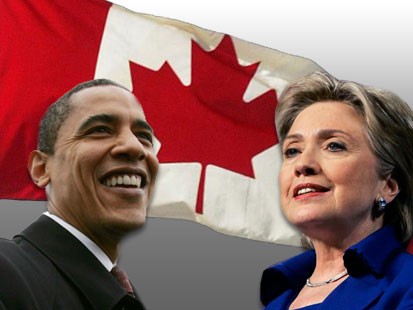
Senators Hillary Rodham Clinton and Barack Obama in the Democratic primaries are criticizing the North American Free Trade Agreement with Canada and Mexico and vowing to renegotiate it to protect American workers.


Clinton, with strong backing from U.S. organized labor, has advocated a "time out" in trade liberalization and questioned whether the theory of comparative advantage that underpins free trade still applies in the 21st century.


On the other side of the Atlantic, President Nicolas Sarkozy of France has urged Europeans to stop being naïve about trade and to develop "a real system of community preferences" to protect European Union agriculture and industry from unfair competition.

[WHAT SARKOZY IS REALLY SAYING, IN NUANCED FRENCH FASHION, IS THAT, GIVEN THE PRESENT ERA OF GLOBALIZATION
IT IS NOW TIME TO UPDATE FORTRESS EUROPE'S PROTECTIONIST DEFENSES WITH NON-TARIFF TECHNICAL BARRIERS TO TRADE DISGUISED AS 'CULTURAL PREFERENCES']


Political opposition has forced the EU's trade commissioner, Peter Mandelson, to delay changes in anti-dumping duties meant to take account of the interests of European firms that produce goods in low-cost countries.


Mandelson has broad powers to negotiate trade agreements on behalf of the 27-nation bloc, but France is doing its best to handcuff him and organized a caucus of 20 farm ministers last month to warn against further concessions on agriculture.


Brussels trade diplomats say that the commissioner, who is British, has long been viewed with suspicion in many member states because of his liberal views on trade and that his influence may be waning.

All this sets a grim backdrop for negotiators at the World Trade Organization, who are preparing yet another "final push" for a global deal to cut tariffs and remove trade barriers. Their aim is to clinch a deal before President George W. Bush leaves office next January.


Turmoil on financial markets and a sharp economic slowdown, especially in the United States, have fueled calls for protecting jobs in wealthy countries.


The trade organization's director general, Pascal Lamy, says the downturn on both sides of the Atlantic should focus minds on the benefits of a trade agreement, not least because failure would damage confidence in the world economy. Keith Rockwell, a spokesman for the agency, said, "Do you fix the roof when the sun is shining or when it's raining? Either way, it's still a good idea to fix the roof."


Politically, a failure of the rules-based multilateral system to deliver progress on trade could undermine European hopes for a more ambitious international agreement in 2009 to curb the greenhouse gas emissions that are blamed for global warming.


As with climate change, a trade deal requires concessions from big emerging nations like India, Brazil and China, which want to be able to protect key sectors of their economies from competition from rich countries.


Those conflicts seriously threaten the trade talks, as does the reluctance of wealthy nations to reduce radically the longstanding protection of their farmers.


"I share the skepticism that anything good will come out of the Doha Development Agenda," said Adam Posen of the Peterson Institute for International Economics in Washington, using the name given to the trade round that began in Qatar in 2001.


Posen said that whoever wins the White House in November, Congress will make trade conditional on labor and environmental standards to shut out cheap competition, mainly from Asia.


Andre Sapir, a trade economist at the Free University of Brussels and former adviser to the European Commission, agrees that the climate in the United States is not favorable for new trade deals, although the Europeans should still push for one.


"You need some bad economic news to make a trade agreement necessary as a booster of confidence," he said. "But even if there is a deal now, the chances are that something is going to be reopened after the U.S. election."


U.S. trade diplomats in Europe are using Clinton's rhetoric and fears of a more protectionist U.S. administration to try to focus on the need to complete a trade deal now.


One senior diplomat, speaking on condition of anonymity because of the sensitivity of the issue, said his message to European counterparts was: "Don't wait for Hillary."

Sunday, March 9, 2008

Policy Implications: Clinton and Obama on International Trade Policy, NAFTA, and SWF’s

Policy Implications: Clinton and Obama on International Trade Policy, NAFTA, and SWF’s


By Osman Aziz


ITSSD Intern, Blogmaster of the ITSSD Journal on Economic Freedom


Much rhetoric has been exchanged on the campaign trail regarding the status of free trade and the future (or lack thereof) it has in American foreign policy. Both democratic hopefuls Hillary Clinton and Barack Obama have been in a perpetual state of flux over the status of NAFTA (North Atlantic Free Trade Agreement) and the perceived ills that it has accrued for the people of America. However acidic such criticisms of free trade may have appeared on the cameras, questions abound to the actual positions of each candidate on the undeniable progress that trade liberalization has taken in the world. Given the track record, neither Obama nor Clinton actually appear to be enemies of a free trade paradigm, which begs the question as to why such critical stances need to be taken against free trade agreements that, on the whole, have provided greater benefits than damages.


“In the minds of hard-core opponents of free trade, both Mrs. Clinton and Mr. Obama have checkered records in the Senate on trade agreements. Both voted against the Central American Free Trade Agreement but supported a trade pact with Peru last year, citing the inclusion of labor and environmental provisions that were not part of Nafta. Opponents, however, said crucial provisions in Nafta that led to jobs being shipped overseas were also part of the Peru agreement. Mrs. Clinton and Mr. Obama were also among only a dozen Senate Democrats who voted for a trade agreement with Oman in 2006.”[1]


The questions being framed as a position of political pandering is undeniable given the records that both candidates have on trade; but the irrefutable consequences of publicly assailing free trade policies could carry over to other aspects of international trade policy. Recent controversy over the ascendancy of Sovereign Wealth Funds (‘SWFs’) and the apparent lack of “transparency” that they possess has sparked a backlash from Democrats and protectionists alike who point to, without proper knowledge, the inherent “political” interests involved in such funds. Senator Obama’s position on altering the tax code to subsidize businesses that keep jobs in the US also smack of an underlying misunderstanding of economic efficiency and the effect such a position can have on inflating the prices of consumer goods by retaining inefficient employment capacities for higher wages.[2]


The Senators' indirect call for more governmental intervention in the reshaping of NAFTA and the US’ global trade policy seems to reflect a broader ideological agenda. First, it would seem that the candidates are attempting to label ‘trade’ as the cause of what many anticipate will be a US recession. Second, it appears that the Clinton-Obama strategy is to cast more not less governmental intervention in the marketplace as the necessary ‘change’ or ‘solution’ that will bring the US out of its current economic malaise. However, with little to say about the causes and eventual outturn that the current subprime crises harbors with it, protectionism and the scepter of populism may only serve to drive the US economy into further disarray. What appears to underlie these sentiments, are the overlooked benefits that such agreements as NAFTA have really had on the US and the region as a whole.


While it is politically incorrect to say so, NAFTA has been good for all of North America. By opening the continent to investment and trade, capital has found more efficient uses, with benefits to producers and consumers alike. In NAFTA's first decade after 1993, trade between the U.S. and Mexico multiplied to $232 billion from $81 billion. Trade with Canada has also blossomed, with Canadian exports to the U.S. by surface transport rising 79% in a decade and U.S. exports to Canada increasing 38%. The deal also increased U.S. productivity. U.S. firms found they could be more globally competitive by putting some manufacturing in Mexico or Canada while retaining high-end production in the U.S.” [3]


By virtue of the fact that the same can be said regarding the projected benefits of the US-Peru FTA a year down the road reveals the hidden side that neither Senator is willing to uncover, namely the increase in economic efficiency that is followed by the passing of such free trade agreements. The very fact that increases in real GDP for all three nations member to NAFTA by approximately 50% each is evidence unto itself of the successes it has yielded, adding further distress to either the withdrawal, or the amending of an agreement that has worked so far.[4] Unilateral withdrawal from NAFTA, a trade agreement that has epitomized the inherent benefits of trade liberalization would be a fool hardy move and would send the wrong signal to the rest of the world regarding the US’s stance on international treaties, which up to this point has been maintained by a track record of trust and reciprocity. The fact that much rhetoric over NAFTA was staged in Ohio begs the question as why such sentiments are not being capitalized on in Texas. Given the fact that Ohio suffers from a six percent unemployment rate may help to explain the shifting positions of Senators Clinton and Obama (whether or not job loss can be attributed to NAFTA is a matter discussed later). The fact that such critical stances haven’t been assumed in Texas is evidence of the Democrats’ incessant need to position regarding the matter of free trade.


“As fiercely as they've fought in Ohio over the issue, the rivals haven't focused much on free trade in Texas, which has seen job growth and a huge spike in exports since NAFTA went into effect in 1994. ‘Every trade agreement has winners and losers,’ said Southern Methodist University economist Thomas Osang, who studies free trade. Texas had many of the industries poised to benefit, notably electronics and chemicals, and those industries outweighed losers such as lumber and furniture roughly 2-1.”[5]


Although Senators Clinton and Obama capitalize on protectionist and neo-mercantilist rhetoric in securing the votes necessary for election, the potential policy implications that such talk will have up to this point seems innocuous at best. What should come at greater concern are new up and coming issues such as SWF’s and sparking further regional trade agreements after aggregate bilateral agreements stabilize macroeconomic policy. Hostility to these new issues have already arisen on the campaign trail, and with no definitive voting record to base any judgment off of, speculation becomes a tricky game. The recent move by the Department of the Treasury to increase oversight of SWF’s and the additional pressure being applied to the IMF, although not nearly as caustic as the perspective promoted by Clinton and Obama, smacks of the age old argument surrounding “oversight” and regulation.


“Second, we have proposed that the international community collaborate on the development of a multilateral framework for best practices. The International Monetary Fund, with support from the World Bank, should develop best practices for sovereign wealth funds, building on existing best practices for foreign exchange reserve management. These would provide guidance to new funds on how to structure themselves, reduce any potential systemic risk, and help demonstrate to critics that sovereign wealth funds can be responsible, constructive participants in the international financial system.”[6]


This sort of even-handed approach by US lawmakers and Hillary Clinton is diametrically opposed to the position adopted by Barack Obama. Citing that the largest investment arms are located predominantly in the Middle East, Obama crafted the debate surrounding SWF’s as a matter of the US’s reliance on oil from the region while ignoring wholesale the fact that such investment vehicles as the Abu Dhabi Investment Authority and Kuwait Investment Authority are reacting as developing countries would be expected to act. Although Senator Obama does echo the sentiment regarding oversight and greater transparency that Senator Clinton trail-blazed, it seems as though it is difficult to assess how these two candidates will react when placed in the Oval Office and are tasked with the responsibility to react to new trends originating from developing nations. The apparent dearth of information regarding such emerging trends as decoupling theory and international financial integration on the part of the politicians vying for office so far reflects a more deeper and profound misunderstanding of the macroeconomic policies that will need emerge in the near future to handle such trends. Subsidizing producers in the US that produce consumer goods will only provide for more expensive goods, which coupled with a weakening dollar, will severely affect foreign nations’ economies which rely off of a robust trade with the US.[7] It seems that the only ostensibly legitimate contentions that the Democrats have so far leveled against the existing establishment are issues over labor and environmental policies.


Contentions over NAFTA: Why the Labor Rights/Environmentalist/Job Loss argument carries little to no weight


The contention that NAFTA has provided for a negative paradigm in terms of labor rights and environmental protections reflect yet another disturbing trend, that of misinformation. Although much talk has been thrown about regarding the lack of a sustainable provision for labor rights in NAFTA, the very fact that a supplemental labor stipulation under the North American Agreement on Labor Cooperation (NAALC) is provided for under NAFTA contradicts such claims.[8] The existence of a five year strategic agreement through the Commission of Environmental Cooperation also provides a framework through which environmental policy can be worked out.[9] Both Hillary Clinton and Barack Obama lambaste NAFTA as the sole perpetrator in the loss of jobs across the board within the US to foreign firms. Although NAFTA never promised a net total increase in jobs themselves, the fact that overall productivity increased significantly during the years that NAFTA has been in affect provides a clear contradiction to the overarching contention of job loss.


“U.S. employment rose from 112.2 million in December 1993 to 137.2 million in December 2006, an increase of 25 million jobs, or 22 percent. The average unemployment rate was 5.1 percent in the period 1994-2006, compared to 7.1 percent during the period 1981-1993… Growth in real compensation for manufacturing workers improved dramatically. Average real compensation grew at an average annual rate of 1.6 percent from 1993 to 2006, compared to just 0.9 percent annually between 1980 and 1993”[10]


The hidden benefits of an increase in overall productivity translate into cheaper consumer goods that would have been much more expensive if left to inefficient producers within the US. Constituency, instead of fact, seems to be playing a more significant role in swaying the supposed sentiments of both Senators Clinton and Obama (although the leaked memo detailing Obama’s “political positioning” may serve to shed a different light on things)[11]. Senator Clinton, whose reliance on the AFL-CIO has pushed her to a more protectionist stance, differs marginally from Senator Obama, whose support hails from the Teamsters and the Service Employees International Union, both of which benefit from increased trade with other nations.[12] Without a clear agenda from either democratic candidate on what they see as the ills of NAFTA and free trade, it seems as though the stances that each candidate has so far amplified has been done so with more emotion than substance. The three primary contentions that each candidate has regarding NAFTA specifically are addressed already within the agreement or are on their way to being accomplished under the current framework, leaving much to be asked about the actual disagreements each candidate has with not only NAFTA, but with free trade as a progressive paradigm.


[1] The New York Times. Despite NAFTA Attacks, Clinton and Obama Haven’t Been Free Trade Foes. February 28, 2008.
[2] The Wall Street Journal. CAPITAL: Decoding Candidates on Trade. February 21, 2008
[3] The Wall Street Journal. Unilateral Democrats. February 28, 2008
[4] US Department of Commerce. NAFTA-A Success for Trade. October 2007
[5] Todd J. Gillman, Gromer Jeffe. McClatchy - Tribune Business News. Punches Fly over Trade, Rival Tactics as Democrats Debate in Ohio. Washington: Feb 27, 2008.
[6] US Department of the Treasury. Under Secretary of International Affairs David H. McCormick Testimony Before the Joint Economic Committee. February 13, 2008
[7] The Economist. Finance and Economics: An Independent Streak: Decoupling 1. Jan. 26th 2008
[8] Office of the US Trade Representative. NAFTA-The Road Ahead. (2007)
[9] Office of the US Trade Representative. NAFTA Environment Ministers Adopt Trade and Environment Stratgeic Plan. (06/23/2005)
[10] Office of the US Trade Representative. NAFTA Facts: NAFTA Benefits. (October 2007)
[11] Financial Times. Obama under fire over NAFTA Memo. March 3, 2008
[12] Bhagwati, Jagdish (Financial Times). Obama’s free trade credentials top Clintons. March 3, 2008

Thursday, February 28, 2008

Candidates Convey Confusion Over Trade: There are No Silver Bullets

Decoding Candidates on Trade


February 21, 2008; Page A2

By DAVID WESSEL

http://online.wsj.com/article/SB120354791005181195.html?mod=googlenews_wsj


The virtues of international trade and the pressures globalization is putting on American workers are becoming more prominent issues in the presidential campaign, even though the candidates most hostile to trade got trounced.


Sen. John McCain, the Republican, is the free trader in the race. "We need to continue to lower barriers to trade because 95% of the world's customers live outside the United States," Mr. McCain said recently in Michigan, where the jobless rate is 7.6%, the highest in the nation. "We need to have competitive manufacturing through lower health-care costs, lower taxes and opening new markets."


Mr. McCain has been a steady supporter of free trade in the Senate -- from the North American Free Trade Agreement to the pending U.S. trade pact with South Korea, which even some trade lovers find flawed.

By contrast, Democratic Sens. Hillary Clinton and Barack Obama are vying to be the bigger trade skeptic. As they fight for Ohio (jobless rate 6%), neither wants the mantle of former President Clinton, who shucked the populist strains of his 1992 campaign and became a champion of Nafta and China's entry into the World Trade Organization.


It's hard to tell their positions apart. In the Senate, both Mrs. Clinton and Mr. Obama voted for a recent trade accord with Peru. Both voted against a Central American trade pact. Both oppose the South Korea deal.


Both voted to whack China for keeping its currency weak. Both back 2004 Democratic nominee John Kerry's plan to use the tax code to reward companies for keeping jobs in the U.S., though Mr. Obama does so more loudly.


Lately, the two have been maneuvering to see who can be nastier about Nafta. In the end, though, neither would abrogate the treaty. She would "review...and work with our trading partners to make necessary adjustments." He would "work to amend."
DISCUSS


What sort of trade policy do you think a President McCain or President Clinton or President Obama would -- or should -- pursue?


Veterans of the Bill Clinton White House say Mrs. Clinton was a loyal soldier, but often unenthusiastic, at best, about her husband's embrace of globalization. Pro-globalization Democrats long have been uneasy about her for that reason.


Until his campaign reached the Midwest, Mr. Obama sounded like the former president. "Like [Clinton Treasury Secretary] Bob Rubin, I am optimistic about...the ability of U.S. workers to compete in a free trade environment -- but only if we distribute the costs and benefits of globalization more fairly across the population," he wrote in his 2006 book. The big-company chief executives who belong to the Business Roundtable say almost the same thing.


But if Bill Clinton were running again, he'd probably put some distance between his campaign and his eight-year presidency. It's the voters, stupid.


In December, a Wall Street Journal/NBC News poll asked Americans whether the increasingly global nature of the U.S. economy was good ("because it has opened up new markets and resulted in more jobs") or bad ("because it has subjected American companies and employees to unfair competition and cheap labor.") By 58% to 28%, the respondents said it was bad.


MORE

• Comparison of where candidates stand on trade (PDF)
From The Wall Street Journal/NBC News Poll:


"Do you think the fact that the American economy has become increasingly global is good because it has opened up new markets for American progress and resulted in more jobs, or bad because it has subjected American companies and employees to unfair competition and cheap labor?"


Dec. 2007 June 1997
Good 28% 42%
Bad 58% 48%
Equally Good & Bad 11% 7%
Not Sure 3% 3%


From the December 2007 poll:
Good Bad Equal/Not Sure
Professionals 37% 50% 13%
White collar 27% 58% 15%
Blue collar 15% 72% 13%
Retirees 23% 62% 15%
* * * * * * * * *

Democrats 25% 63% 12%
Republicans 32% 55% 13%


By contrast, in August 2007, the question drew a much less-hostile response: 48% bad to 42% good. (The rest weren't sure or deemed globalization equally good and bad.) President Bush has done little to ease Americans' anxiety; even some of his own appointees won't defend the administration's rejection of Democratic overtures on shoring up assistance to workers hurt by trade.


So what happens after Inauguration Day? Even Mr. McCain, if eager to press Mr. Bush's trade-pact agenda, would be likely to face a Democratic Congress elected by voters who, though they may shop for imported underwear at Wal-Mart, believe globalization is holding down their wages.


Neither Mrs. Clinton nor Mr. Obama is likely to be able to do much about trade deals already in effect, despite their campaign rhetoric. Neither, even in the heat of the Midwestern spotlight, is talking about new barriers to trade. The Depression-era Smoot-Hawley tariffs aren't coming back. And the Democrats' trade hard-liner, former Sen. John Edwards, has dropped out of the race.


The issue really is about what happens going forward. And the most likely answer on trade is not much. Barring an unlikely breakthrough in the Doha Round of world trade talks, neither Democrat is likely to make trade deals -- even renegotiated to incorporate labor and environmental standards -- a top priority.


The fate of the deal with South Korea will be the most important early test case: It's a big economy, far more significant than Peru or Panama. The new Korean government might be willing to reopen the agreement to save the pact from a Democratic president pledged to oppose it. But even if Mr. Obama wins, the "timeout" on trade deals that Mrs. Clinton proposes is the most likely outcome. And that could turn out to be a route to maintaining good parts of globalization, which would lose an up-or-down vote right now.


The anxiety about globalization among a huge swath of the electorate reflects widespread economic insecurity and a sense that the U.S. economy isn't delivering the goods for many. Tweaking trade deals or adding another program for workers hurt by imports won't salve those fears.


A "timeout" to try to fix flaws in the American health-care system and to streamline and expand worker-assistance programs so they help workers cope both with technology and trade could be the key to preserving the benefits of globalization in the long run.

Monday, February 4, 2008

State of the Union address: President Bush discusses Free Trade, Protectionism and Doha

State of the Union address: President Bush discusses Free Trade, Protectionism and Doha


Excerpt from Bush's final State of the Union address - Jan. 28, 2008:


"On trade, we must trust American workers to compete with anyone in the world and empower them by opening up new markets overseas. Today, our economic growth increasingly depends on our ability to sell American goods, crops, and services all over the world. So we are working to break down barriers to trade and investment wherever we can. We are working for a successful Doha round of trade talks, and we must complete a good agreement this year. At the same time, we are pursuing opportunities to open up new markets by passing free trade agreements.


I thank the Congress for approving a good agreement with Peru. Now I ask you to approve agreements with Colombia, Panama, and South Korea. Many products from these nations now enter America duty-free, yet many of our products face steep tariffs in their markets. These agreements will level the playing field. They will give us better access to nearly 100 million customers. And they will support good jobs for the finest workers in the world: those whose products say 'Made in the USA.'


These agreements also promote America's strategic interests. The first agreement that will come before you is with Colombia, a friend of America that is confronting violence and terror and fighting drug traffickers. If we fail to pass this agreement, we will embolden the purveyors of false populism in our hemisphere. So we must come together, pass this agreement, and show our neighbors in the region that democracy leads to a better life.


Trade brings better jobs, better choices, and better prices. Yet for some Americans, trade can mean losing a job, and the Federal Government has a responsibility to help. I ask the Congress to reauthorize and reform trade adjustment assistance, so we can help these displaced workers learn new skills and find new jobs."